

Start with the criteria, then the name
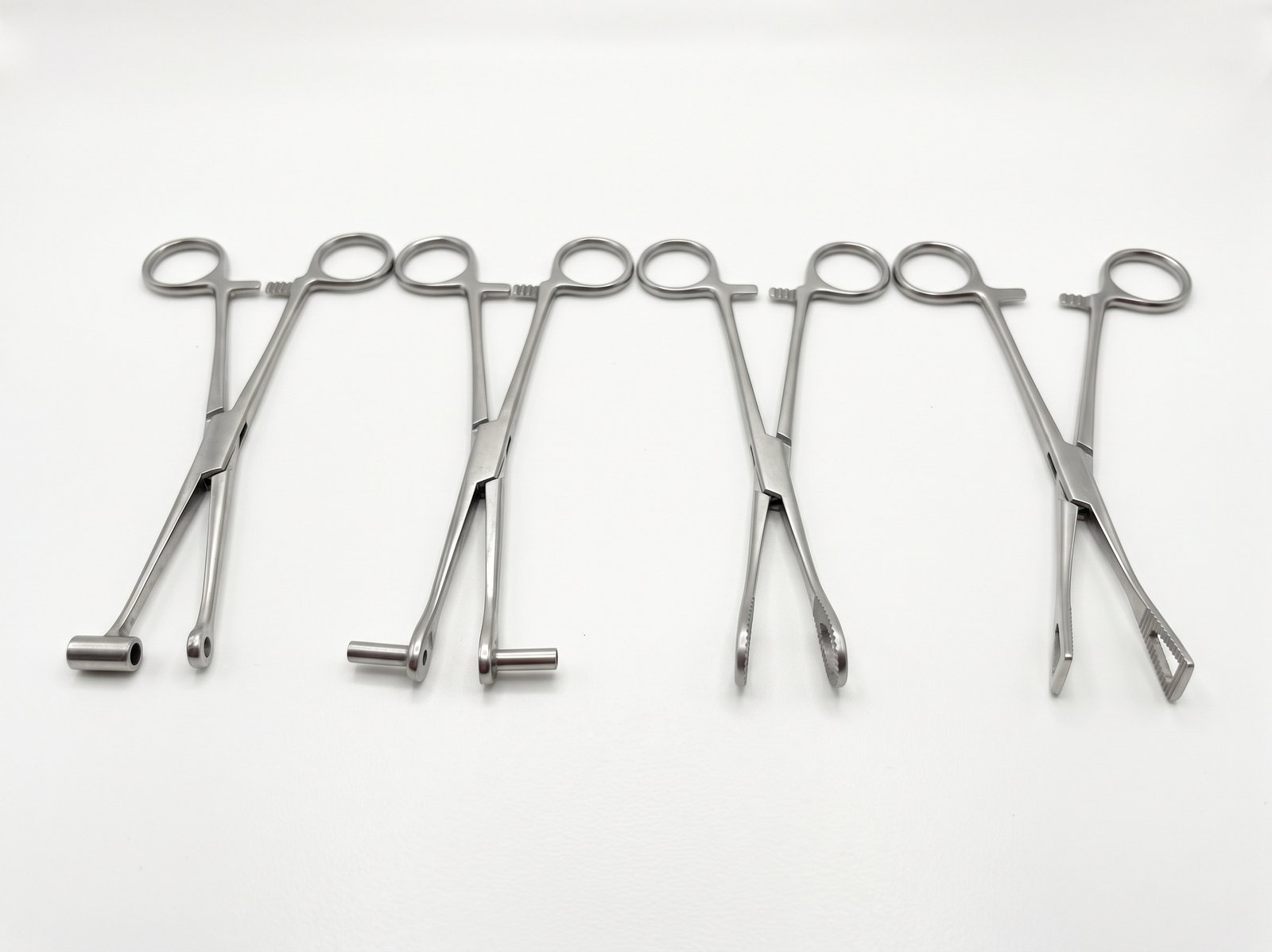
In commercial terminology, "piercing forceps" covers instruments with different shapes and tasks. It is useful to separate at least three groups: forceps that grip or temporarily stabilise tissue; specialist models, such as forceps with tubular ends sold for septum piercing; and jewellery tools designed to manipulate components, not tissue.
Pennington, Foerster/Forester and septum forceps appear both in surgical catalogues and in ranges described by manufacturers of body-piercing instruments. Catalogues allow names and configurations to be compared; they do not by themselves certify a model as suitable for a procedure or a particular anatomy.
There is no single commercial taxonomy shared by all manufacturers: the same name may cover different lengths, jaws and openings. Always identify the individual product, not just the eponym.
Piercing forceps models
These families are documented in catalogues from manufacturers of surgical instruments and body-piercing tools. A product specification describes that model; it does not establish a universal technique or suitability for every anatomy.
Pennington
The Pennington model is recognisable by its triangular jaws; surgical instrument catalogues document fenestrated and serrated variants, with sizes depending on the specific catalogue code. One body-piercing instrument manufacturer includes Pennington forceps in its range. Opening, tips and compatibility cannot be inferred from the name alone: check the specification and instructions for the model actually purchased.
Foerster (sometimes spelt Forester)
Foerster, also known assponge forceps(sometimes spelt Forester), is a model distinct from Pennington. Surgical catalogues show straight or curved variants and smooth or serrated surfaces; a body-piercing instrument manufacturer also lists Sponge/Forester forceps in its range. Shape and opening vary by code: check the specification rather than inferring a technique or clinical use from the name.
Septum forceps
Septum forcepsis a family of instruments offered by body-piercing tool manufacturers in several models. There is no universal "Style" numbering across brands: the shape of the tips, dimensions and needle compatibility must be checked in the individual product specification and relevant instructions.
Kelly and haemostatic forceps
Kelly is a forceps model found in surgical catalogues, with straight and curved variants. It is distinct from Pennington and Foerster; the name, tip shape or presence of a ratchet does not demonstrate suitability for body piercing. Check the product, its stated purpose and the manufacturer's instructions.
Specialist and jewellery forceps
Body-piercing tool manufacturers' catalogues also distinguish tools for dermal anchors, ring-opening or ring-closing pliers, and tools for holding components or ends. These are jewellery or component tool families, not synonyms for tissue-gripping forceps and not interchangeable with them.
Geometric descriptions and instructions for use are two different things."Triangular", "oval", "tubular", "straight", "curved", "smooth" and "serrated" describe features of a model; they do not by themselves say which procedure is intended. For openings, fenestrations or split tips, refer to the technical drawing and documentation for the specific product code.
Materials and reprocessing
The label "surgical steel", the steel grade, or the fact that forceps are sold to piercers is not enough, on its own, to prove that the product is reusable or compatible with an autoclave cycle. Before purchase or reuse, identify the manufacturer, product code, finish and instructions for use (IFU); check that the stated purpose includes the intended use and that the IFU specifies cleaning, maintenance and sterilisation.
Cleaning comes before sterilisation and must reach joints, ratchets, slots and internal tip surfaces too. Follow the model instructions for opening or disassembly, detergents, lubrication and cycle parameters. Inspect alignment, closure and surfaces; do not reuse the instrument if it is damaged or cannot be treated as prescribed.
The CDC and WHO sources cited below support general principles for medical-device reprocessing; they do not provide instructions for a piercing forceps model. For the instrument, follow the manufacturer's guidance and the rules applicable at the workplace.
How to compare models
Before introducing an instrument into the studio, write down its full name and product code; then compare at least these points against the specification and IFU:
- Task and stated purpose:distinguish tissue gripping, support for a particular site, dermal-anchor handling or jewellery work.
- Tip shape:triangular, oval/ring-shaped or tubular; straight or curved; smooth, serrated, fenestrated or another configuration stated by the manufacturer.
- Usable opening:for a slotted or tubular model, check the stated measurement and actual compatibility with the intended needle. Do not rely only on the trade name or a gauge claim in a generic description.
- Closure and condition:check jaw alignment, hinge, ratchet, burrs, corrosion and the integrity of the finish.
- Reprocessing:check the IFU for reuse and the intended cycle; do not infer either from the material or from the word "autoclavable" when the product has not been identified.
Practical assessment of access, visibility and compatibility with the anatomy is part of the piercer's training and local rules: this article identifies models and variants; it does not teach a technique or prescribe which forceps to use on a person.
FAQs
Are Pennington and Foerster the same forceps?
No. Pennington typically has triangular jaws; Foerster has oval or ring-shaped tips. Variants and sizes differ by manufacturer and model.
Is a slotted or open variant compatible with every needle?
No. Geometry and usable dimensions depend on the specific model; check the manufacturer's documentation and do not infer compatibility from the family name.
Does the name Foerster indicate a piercing site?
No. It identifies an instrument model, not a site or universal intended use. Check the stated purpose for the exact product.
Do all septum forceps have the same configuration?
No. Manufacturers distinguish several models and styles; check the exact product specification for shape, dimensions and compatibility.
Can jewellery pliers replace tissue forceps?
No. They are designed for different tasks and should not be treated as interchangeable.
Do the cited sources define which forceps to use for every piercing?
No. Catalogues describe models and configurations; they do not establish a clinical rule valid for every anatomy or procedure.
Sources and limitations
Sources consulted on 14 October 2026. Manufacturer catalogues document features and variants of specific instruments; the Orebro range lists types of forceps and tools sold as body-piercing tools. These specifications do not establish clinical indications or a universal technique. An IFU for a model specifically intended for piercing was not verified: for reuse and sterilisation, the IFU for the actual product purchased is authoritative.
Manufacturer catalogues
- Orebro International - body-piercing tools, including Pennington, Sponge/Forester and Septum forceps, as well as jewellery tools
- Teleflex / Pilling - Pennington Forceps, catalogue 475250
- B. Braun / Aesculap - Pennington Grasping Forceps, model BH902R
- Sklar - Foerster Sponge Forceps, model 87-2095, straight and smooth
- Sklar - Foerster Sponge Forceps, model 87-2295, curved and smooth
- Sklar - Foerster Sponge Forceps, model 87-2395, curved and serrated
- Teleflex / Pilling - Kelly Forceps, catalogue 182100, straight
- Teleflex / Pilling - Kelly Forceps, catalogue 182110, curved