
Earlobe piercing is often presented as a simple procedure, but choosing a method involves several factors: how the device passes through the tissue, how the area is prepared, which jewellery remains in the piercing, and whether the operator can manage the process under suitably hygienic conditions. Reducing everything to “needle versus gun” risks obscuring the very differences that matter.
The comparison should distinguish good professional practice from comparative clinical evidence: not every histological or statistical claim circulating on this subject has been demonstrated by direct studies of earlobes.
Two different mechanisms, not a universal measure of harm
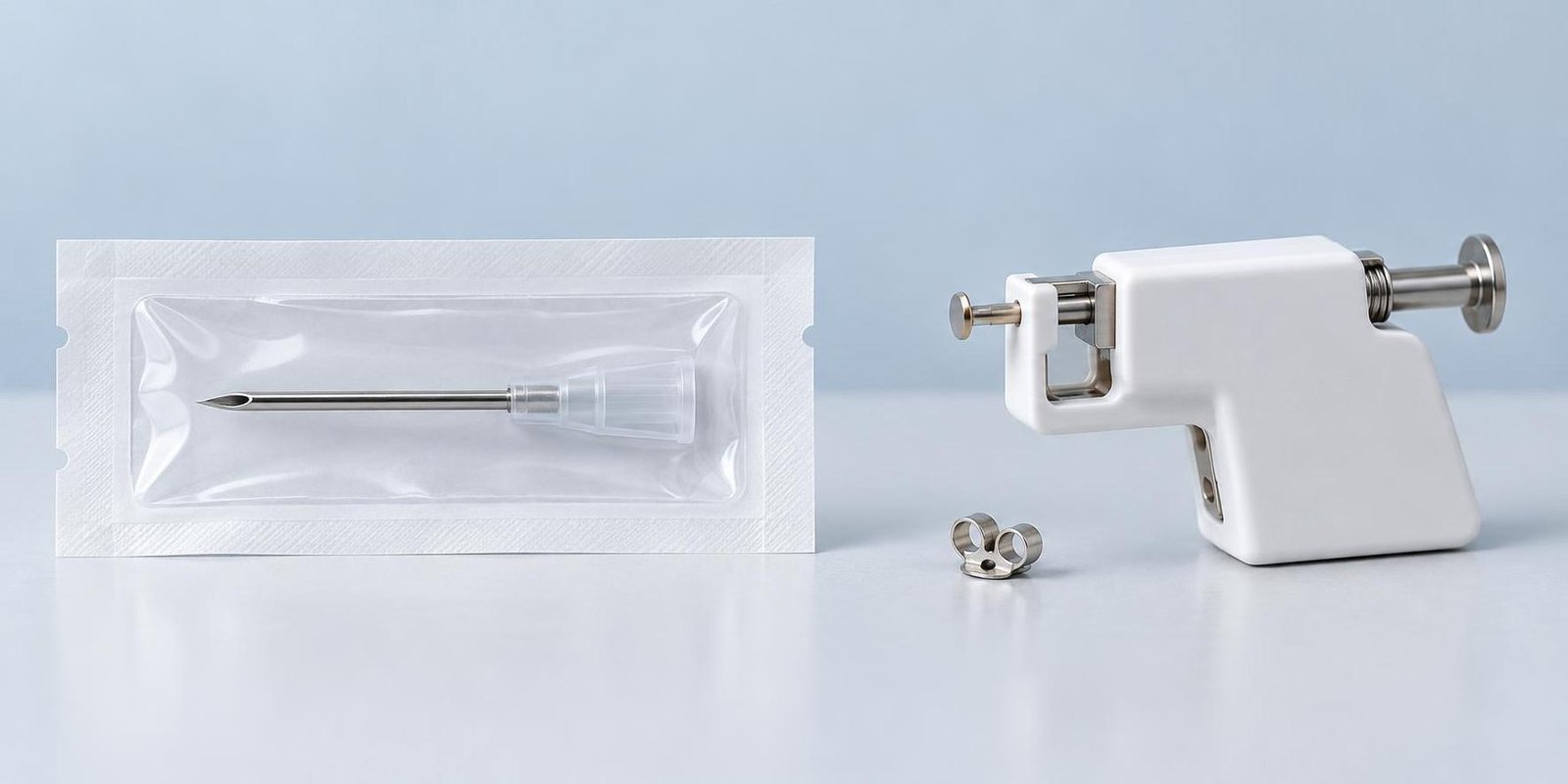
With needle piercing, the practitioner guides a sterile, single-use needle by hand through the marked point and can adapt the angle and position to the anatomy observed. The type and geometry of the needle depend on the product. This description alone cannot quantify microscopic tissue damage or predict an individual’s healing course.
With pressure devices, a pre-loaded post is pushed through the lobe when the system is activated. This describes the device’s mechanics: it does not, by itself, quantify any tissue damage or predict healing.
There are different systems, including reusable devices, manual devices with single-use cartridges and other designs. A single-use cartridge may alter some aspects of contact between the device and client, but it does not automatically change the jewellery geometry, the need for correct placement or the operator’s preparation.
What do the sources actually show?
The concerns discussed in professional comparisons relate chiefly to sterility, how the tissue is pierced and jewellery design. Professional recommendations help define a standard of practice, but they are not equivalent to a comparative clinical study of every device currently on the market.
Potential problems affecting a pierced lobe include minor infections, allergic dermatitis, keloids and traumatic tears. Post length and clasp pressure matter too: an earring designed for the lobe is not automatically suitable for other sites. These observations describe possible piercing complications; they do not establish that one technique causes a particular proportion of problems.
The practical conclusion remains cautious: a procedure allowing manual control and individual jewellery selection offers factors to consider, but stronger claims—“always clean” histological margins, quantified necrosis, specific cytokines or superior healing—require relevant comparative evidence. The sources listed below do not demonstrate a quantifiable clinical advantage for either earlobe technique; we should not turn hypotheses into certainties.
Initial jewellery is part of the procedure
The insertion method is not the only factor to assess. The length, gauge, shape and material of the jewellery should suit the site and the individual’s anatomy. Jewellery that is too tight can compress the tissue and leave little room for possible swelling; jewellery that is too long can snag and be pulled. Selection and any subsequent check should be considered in context, rather than applying identical measurements or timings to everyone.
Many pre-loaded earrings are paired with a post and clasp designed for that system. A bulky or overly tight back can make the area harder to clean and inspect, while a fixed length will not necessarily suit every lobe. Post length and clasp pressure are among the reasons why an earring designed for the lobe is not automatically suitable for another site.
In a professional protocol, jewellery is selected for the placement and the space the tissue needs, using materials and documentation consistent with the studio’s adopted standard. “Surgical steel” or “titanium” without a grade, documentation and product identification is not enough to verify a particular alloy.
Hygiene: distinguish devices; do not rely on the label
A reusable device and a single-use head do not have the same operating profile. Some traditional reusable plastic devices are not compatible with autoclave sterilisation; external cleaning alone does not show that internal parts have been treated. Features and instructions vary by model, so this description should not be applied to every cartridge system.
Calling a cartridge “single-use” does not replace a complete protocol: intact packaging, use according to the manufacturer’s instructions, hand hygiene, gloves, skin preparation, materials handling and contamination prevention during the procedure remain separate considerations. A single-use component may reduce some routes of contamination, but does not by itself prove that the entire process is sterile or correct.
A sterile, single-use needle, if its packaging is intact and the product is correctly identified, is intended for one use; the practitioner guides it by hand. Here too, the word “needle” is not enough: packaging, stated sterility, integrity, traceability and proper handling are part of professional checks. Applicable requirements also depend on the rules and health guidance in the territory where the procedure takes place.
A professional assessment, step by step
- Identify the exact system.Distinguish a reusable device, a single-use cartridge and the specific model. Do not infer sterilisation compatibility or operation from the word “gun” alone.
- Check the instructions and packaging.Confirm the product is identifiable, intact and used within the manufacturer’s instructions. Do not improvise cleaning or sterilisation procedures.
- Assess the lobe and placement.Anatomy, tissue thickness and the intended position need individual assessment. Avoid promising symmetry or an identical biological outcome for everyone.
- Examine the jewellery before choosing a technique.Consider usable length, gauge, clasp, surface and documented material, not just the front-facing appearance.
- Follow the complete hygiene protocol.Choosing a needle or cartridge does not replace training, preparation of the area, glove management or local procedures.
- Explain the limitations transparently.If a comparison is based on an association’s position rather than direct clinical data, say so. Do not use statistics or microscopic mechanisms that cannot be traced to a verifiable source.
Frequently asked questions
Does a needle guarantee faster healing?
No. The cited sources establish neither a guarantee nor a comparative healing time. Healing depends on several individual factors and aftercare.
Are all piercing guns reusable and impossible to sterilise?
No. Different systems exist. Check each device’s instructions and manufacturer documentation; the features of one specific system should not be generalised to every model.
Does a single-use cartridge eliminate every risk?
No. It may affect some parts of the process, but does not by itself demonstrate that the whole procedure is sterile, that the jewellery is suitable or that the operator is competent.
Is it proven that a gun causes more infections or scarring?
The cited sources describe concerns and possible complications, but do not provide a reliable comparative estimate applicable to every system. We should therefore avoid universal figures and causal claims.
Sources and references
Sources consulted on 14 October 2026. Claims are limited to the scope actually addressed by the sources.
- Association of Professional Piercers (APP),Issues with Piercing Guns. The association’s position on reusable guns, devices and jewellery design.Official page.
- Association of Professional Piercers (APP),Jewellery for Initial Piercings. Professional guidance on the size, style, materials and documentation of initial jewellery.Official page.
- Meltzer DI. “Complications of Body Piercing.”American Family Physician. 2005;72(10):2029–2034. General clinical review of complications, including risks that may affect the earlobe and pressure from the clasp.Article.