

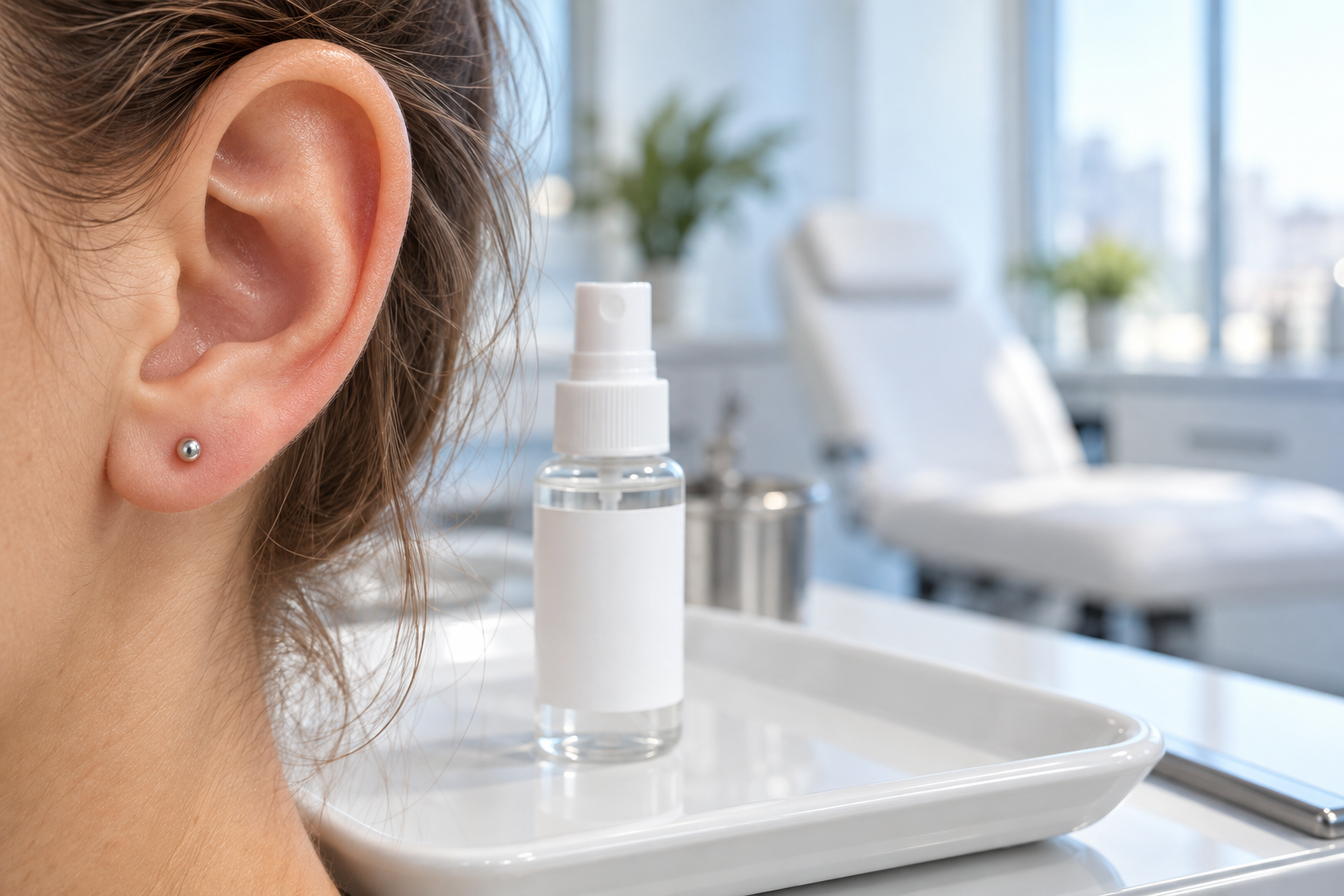
Many clients see redness, tenderness or a small amount of discharge and reach for antibiotic cream, alcohol, hydrogen peroxide or a disinfectant. The studio's role is to offer clear, cautious guidance: a healing piercing should not be treated like a surface that needs sterilising with every wash.
In brief:For routine care, choose a sterile wound wash containing 0.9% sodium chloride, with no additives. Avoid alcohol, hydrogen peroxide, iodine, harsh cleansers and preventive ointments. Use a topical medicine only when a healthcare professional recommends it for an assessed situation.
1. The piercing channel needs time and minimal interference
A piercing passes through tissue and remains open around the jewellery while the channel heals. The surface may look settled before the inner parts have matured: healing progresses from the outside in, and the inner tissue may still be fragile. The external appearance alone therefore does not show that the channel has healed.
This does not mean that every discharge or red area is normal, nor does it allow a diagnosis from a distance. Rather, it means avoiding the assumption that every sign is an infection and avoiding unnecessary products. Friction, pressure, handling and unsuitable jewellery can contribute to irritation; the studio can check jewellery and habits within its remit without replacing a clinical assessment.
2. Alcohol, hydrogen peroxide and antiseptics: not everyday cleansers for a piercing
During healing, alcohol, hydrogen peroxide, iodine, antibacterial soaps and other harsh products can damage cells and irritate tissue. Also avoid products containing benzalkonium chloride (BZK): they can be irritating and are not intended for prolonged wound care.
A disinfectant used for another purpose does not thereby become suitable for repeated application inside a healing channel. Do not recommend improvised dilutions or protocols; if a product has been prescribed or recommended by a doctor for a specific problem, the client should clarify with that professional how to use it on the piercing.
3. Antibiotic ointments: no preventive use without advice
Ointments are not part of daily piercing care: they can be occlusive and make cleaning more difficult. This advice concerns piercing aftercare and should not be turned into a universal rule for all wounds; treatment depends on the type of injury and the clinical reason.
For a minor, uninfected skin wound, the American Academy of Dermatology notes that over-the-counter topical antibiotics are often unnecessary and can cause itchy or painful contact dermatitis. This recommendation concerns general skin care, not a piercing protocol; it is nevertheless a reason not to suggest preventive antibiotic ointment without a healthcare assessment. Unnecessary antibiotic use also contributes to the wider problem of antimicrobial resistance.
If a doctor considers medication necessary, the client should follow the prescription and ask for any specific instructions about jewellery and cleansing. A piercer should not replace a healthcare professional when choosing medication, or interpret a temporary reduction in redness as proof that the cause has been resolved.
4. Irritation and infection cannot be distinguished from a single photograph
In piercings performed and cared for properly, irritation and allergies are described as more common than infections: this is a general indication, not a statistic for every studio or an individual diagnosis. Redness, tenderness or clear/pale discharge that forms crusts can occur during healing; on their own, these do not confirm an infection.
Refer the client to a doctor without delay if they report significant or worsening pain, redness or swelling, heavy and foul-smelling discharge, red streaks, fever, chills or general malaise. Do not prescribe treatment or decide independently to remove the jewellery: if infection is suspected, the decision about jewellery and treatment should be coordinated with a healthcare professional.
A useful message for the client:"I can help you check the jewellery and possible sources of pressure or friction. If your symptoms are severe, getting worse, or you feel unwell, contact a doctor promptly; do not start an ointment or antibiotic on your own."
5. A simple protocol to explain in the studio
Quick summary of the products most often mentioned
| Product | Routine guidance | How to explain the limitation |
|---|---|---|
| Alcohol, hydrogen peroxide, iodine and harsh cleansers | Do not use them for daily cleaning of a healing piercing. | They can irritate or damage cells; effects depend on the product and how it is used. |
| Products containing benzalkonium chloride (BZK) | Avoid them in routine aftercare. | They can irritate and are not intended for prolonged wound care. |
| Antibiotic ointments | Do not apply preventively or for self-medication. | They are not part of routine aftercare; topical antibiotics can also cause contact dermatitis. Follow any prescription with the doctor. |
- Clean hands:Wash them before touching or cleaning the piercing.
- Gentle cleansing:If needed for routine care, use a sterile wound wash containing 0.9% sodium chloride as its only ingredient (purified water may also be listed). Avoid nasal sprays, contact lens solutions and solutions with additives: they are not equivalent to sterile wound wash.
- Drying and handling:Dry with a clean, single-use material; do not rotate the jewellery or scrub vigorously. Rotating the jewellery is unnecessary and can irritate the piercing.
- No preventive "extras":Do not add alcohol, hydrogen peroxide, iodine, harsh antibacterial soaps, BZK or ointments to the routine unless a healthcare professional has given specific advice.
- Review and referral:If there is a problem, check jewellery size, style and material without forcing anything, and consider possible mechanical causes; refer to a doctor for signs of infection or worsening symptoms.
Consistency matters more than the number of products: cleaning too often or using strong products can irritate and delay healing.
6. Frequently asked questions
Does clear or pale discharge mean infection?
Not necessarily. Whitish or pale yellow discharge and crusts can appear during healing. A large amount, bad smell, increasing pain or general symptoms instead need medical attention.
Is saline the only possible treatment?
No. It is a routine cleansing option; it does not replace medical assessment or treatment when there is an infection or another condition. Do not automatically extend advice intended for different wounds to piercings.
The client has already applied an ointment: what should I say?
Encourage them not to add other products, to describe what they used and for how long, and to seek healthcare advice if an itchy or painful rash, swelling or other symptoms develop. Discourage further attempts at self-medication.
Conclusion
For routine aftercare, the message is simple: gentle cleansing, minimal handling and no self-medication with disinfectants or ointments. Piercing guidance does not replace medical assessment; helping the client also means recognising when symptoms require a healthcare professional.
Sources and limitations
- Association of Professional Piercers (APP) - Suggested Aftercare for Body PiercingsGuidance on piercing cleaning, sterile saline, products to avoid and features that can occur during healing. Consulted on 14 October 2026.
- Association of Professional Piercers (APP) - Body Piercing TroubleshootingPossible causes of complications, inappropriate products and signs that warrant medical attention. Consulted on 14 October 2026.
- American Academy of Dermatology (AAD) - When to Use (or Not Use) Antibiotics on Your SkinPublished on 15 February 2022; covers minor skin wounds generally and is not a piercing guideline. Consulted on 14 October 2026.
Sources consulted on 14 October 2026. Professional guidance does not replace an individual healthcare assessment.