
What downsizing is and why it needs explaining
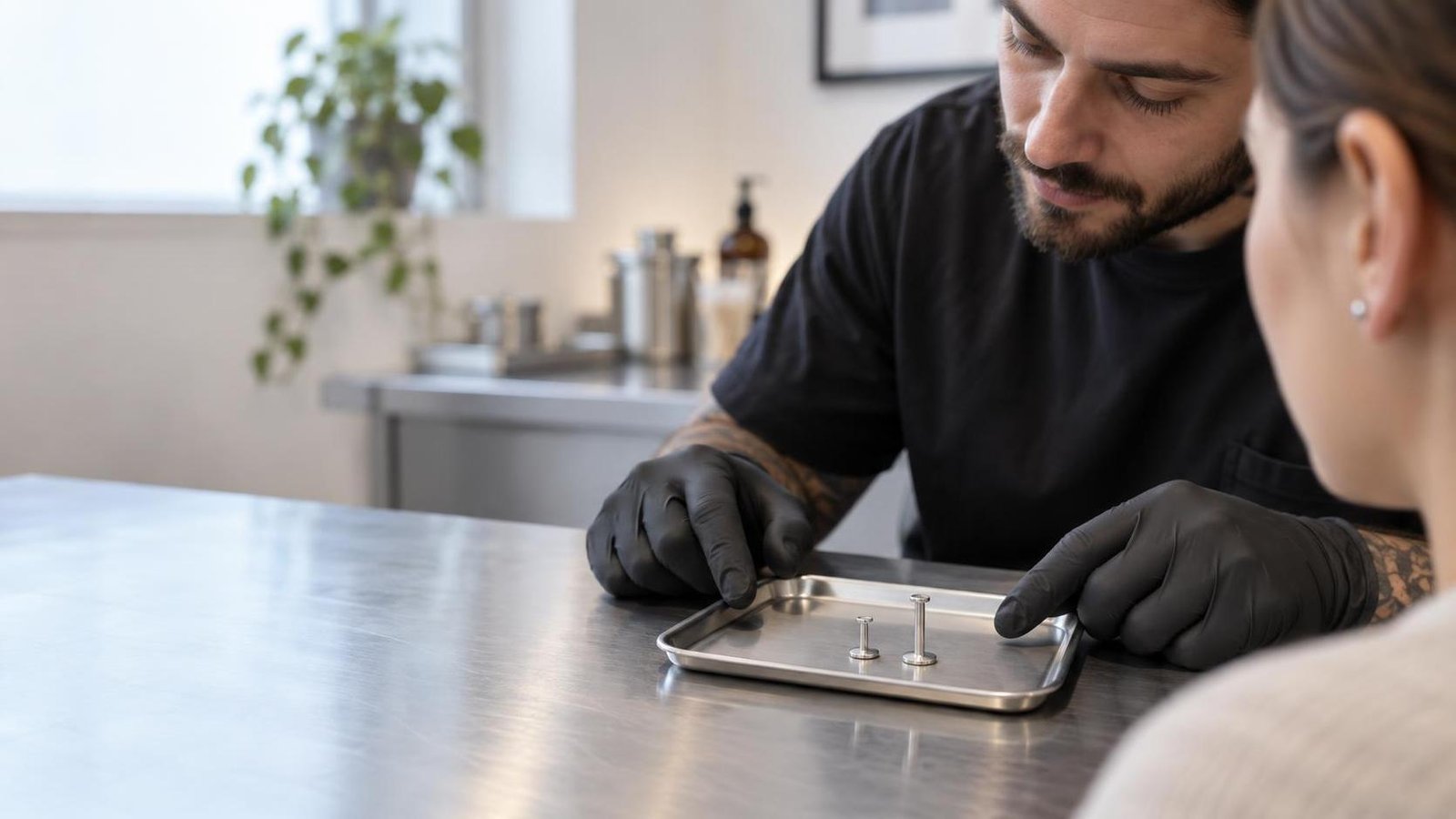
Initial jewellery needs to take account of the placement and the space required at the outset. As swelling subsides, a length that was useful initially may become excessive for the anatomy and stage of healing. Downsizing is the assessment - and, where indicated, replacement with a shorter length - carried out by the piercer during healing.
An unsuitable fit may make the jewellery more likely to snag or be knocked; jewellery that is too tight, on the other hand, may compress the tissue. A standard length should therefore not be prescribed remotely, nor should a chart replace an individual assessment. Selection should take account of placement, anatomy, the jewellery in place and the healing observed.
Downsizing does not certify that the channel has healed, nor does it automatically determine when it is appropriate to switch to a ring or different decorative jewellery. These are separate decisions, based on the piercing’s maturation and the characteristics of the piece.
Assessment comes before the calendar
The timing of a check-up and any downsizing should be assessed for each piercing individually. The studio can suggest an approximate window for a check-up, explaining that the appointment is to assess the situation, not an automatic change date. Many piercings need a shorter length before they are fully healed; during this stage, changes should be entrusted to a qualified piercer.
At the check-up, the piercer assesses whether the remaining space is appropriate for the placement and jewellery, whether the current fit is still needed at this stage, and whether there is irritation or trauma requiring further assessment. If the situation is unclear or a change is not appropriate, it can be postponed and another check-up arranged. Symptoms suggesting a health problem require help from a healthcare professional: an in-studio check-up is not a medical diagnosis.
A four-step follow-up protocol
1. Set expectations before the procedure
During the consultation and consent process, explain that the initial jewellery may need to be checked and, if indicated, shortened before healing is complete. Explain that timing varies and that clients should not shorten or replace the jewellery themselves. Describe what the check-up includes and any costs that may apply.
2. Give clear instructions for returning
Before the client leaves the studio, agree when they should get back in touch or book a check-up window that fits the initial assessment. Provide a way to raise concerns and explain that significant pain, worsening symptoms or possible signs of infection should be discussed with a healthcare professional without waiting for the routine downsizing appointment.
3. Book and remind without pressure
Offer to book at the point of payment, while making clear that the appointment can be moved if reassessment shows that it is not yet time for a change. A service reminder may help clients remember the appointment; use only channels and data handled in accordance with applicable privacy rules and the client’s stated preferences. Avoid messages that present a change as compulsory by a fixed date.
4. Record the essential technical decision
To support continuity at later check-ups, record only the technical details needed for the service, such as placement, jewellery type, fit and the decision made. Decide in advance what information is genuinely needed and how it should be handled under the procedures and requirements applicable to the studio.
Jewellery, fit and changes during healing
The replacement piece must be compatible with the piercing, placement and observed anatomy. For materials, quality and construction, a marketing label such as “titanium” or “implant grade” is not enough: check the relevant designations and documentation. Also check the manufacturer’s instructions and compatibility between components, threading and fastening system.
The procedure must fit the studio’s hygiene and operational workflow and follow the applicable instructions for the jewellery and tools used. Do not improvise a transfer technique or sterilisation sequence based on a general guide: the sources reviewed for this article do not establish a universal protocol for tools or tapers.If the design and compatibility allow, replacing only the post while retaining the decorative end may be an option to explain to the client. Do not assume that components from different brands or systems will fit together, or that reuse is always possible: check the model, the condition of the piece and the manufacturer’s instructions.
Switching to a ring, clicker or more elaborate end is an aesthetic change, separate from downsizing. Do not present it as an automatic result of the check-up: agree a later reassessment once the piercing has healed sufficiently for that type of change.
Transparent pricing and communication
There is no single pricing model that suits every studio. The initial price may include a check-up and, where applicable, a replacement post; alternatively, the visual check-up may be free, with the component charged for when a change is made. Whichever arrangement is chosen, explain it in advance, including what is covered, what may incur a charge and what happens if the change is postponed.
Transparency reduces surprises and helps clients plan their return. Avoid unsupported conversion figures or promises of customer retention: the professional aim is to make a useful assessment accessible, not to make it conditional on buying additional jewellery.
From check-up to an ongoing relationship
A check-up is an opportunity to listen to the client, check the jewellery and clarify the next steps. If they are interested, you can show a selection of ends or discuss an ear-curation plan, clearly distinguishing an aesthetic suggestion from a technical need. The choice must remain voluntary and must not affect the downsizing decision.
A concise technical record can help a client find the gauge, length and jewellery system again in future. Share this information in an understandable way and retain only what is needed. Do not promise that a recorded fit will always be right: anatomy, placement and jewellery can change, and every new application needs to be checked.
Good follow-up is not measured solely by a return to the till. It is reflected in realistic expectations, reasoned decisions, clear costs, and a client who knows when to contact the studio and when to seek healthcare.
Frequently asked questions
Does downsizing mean the piercing has healed?
No. Jewellery may need shortening before healing is complete. A check-up and change do not certify that the piercing has healed.
Can I change the bar myself?
During healing, downsizing and other changes should be entrusted to a qualified piercer. Do not force the jewellery or improvise a replacement.
When is the right time to shorten a labret or a bar?
There is no single date that applies to everyone. The studio can suggest a check-up window, but fit and timing should be assessed for each piercing individually.
When can I switch to a ring?
Downsizing and switching to a ring are different decisions. Ask your piercer to assess it and wait until the piercing is suitable for the intended change.
Sources and limitations
- Association of Professional Piercers (APP), “Aftercare”— notes that many piercings need downsizing before they are fully healed and recommends that changes during healing be carried out by a qualified piercer.
- Association of Professional Piercers (APP), “Jewelry for Initial Piercings”— criteria for the fit and style of initial jewellery, compatibility and materials.
Pages consulted on 14 October 2026. The APP page “Why is it important to downsize a piercing?” cited in earlier material was not used: the URL returned HTTP 404 during verification. This article does not establish universal clinical timelines, market rates, Italian legal obligations or sterilisation protocols; these should be checked in the specific context of the studio.