
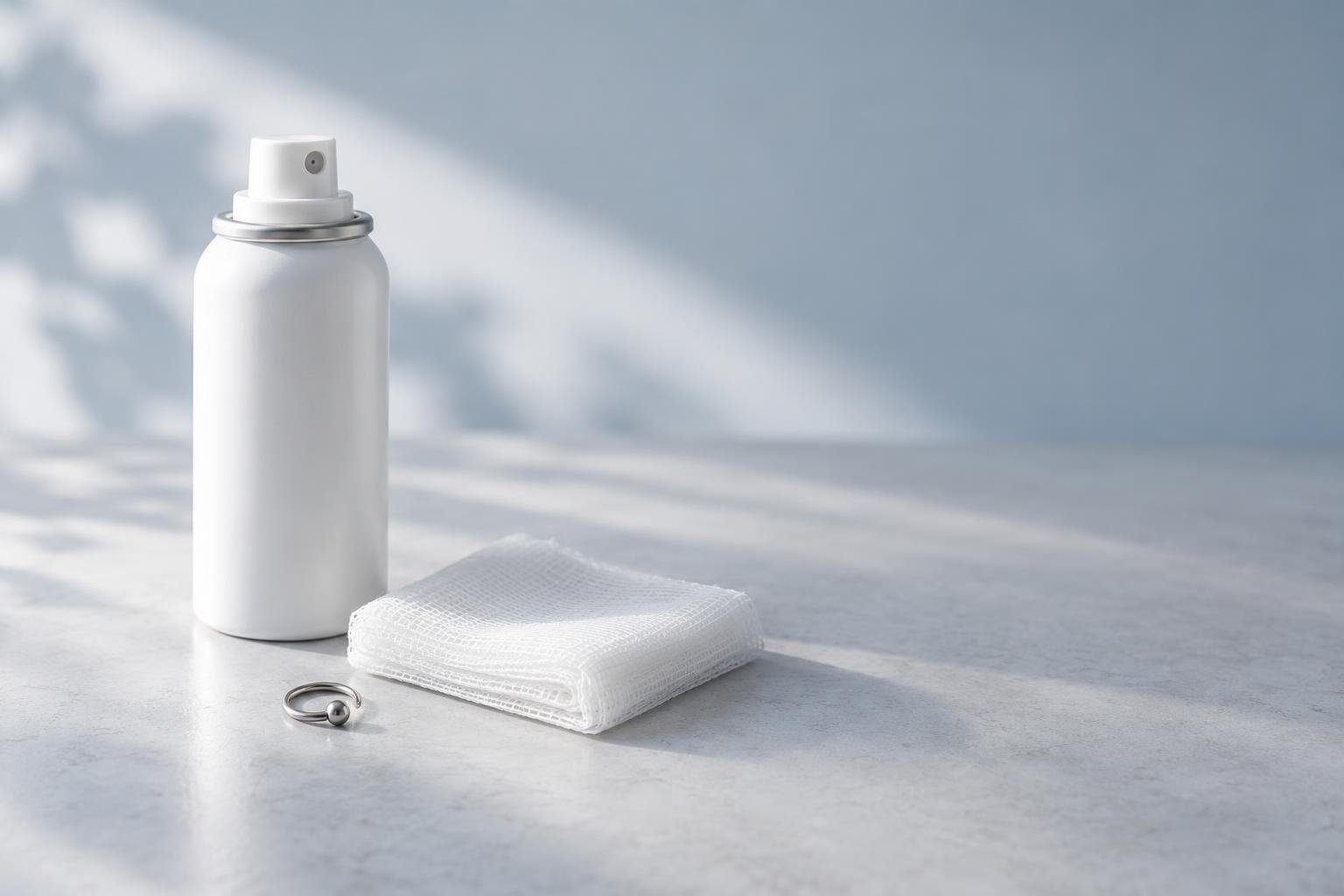
What is saline?
A 0.9% sodium chloride (NaCl) solution contains 0.9 g of salt per 100 ml of water. Labels for 0.9% injectable solutions report a calculated osmolarity of 308 mOsm/L and describe them as isotonic; this figure relates to the product formulation and, by itself, does not show that a solution speeds piercing healing.
When cleaning a healing piercing, a sterile solution suitable for irrigation may help gently rinse away secretions and residue. It is not a disinfectant and does not replace the normal healing process or a healthcare assessment when one is needed.
Evidence and limitations: what can we conclude?
Professional aftercare guidance recommends simple cleaning with minimal handling; the Cochrane review on cleansing wounds other than piercings did not establish with certainty which solution improves infection outcomes or healing. It is therefore not accurate to present saline as a treatment that prevents every infection, eliminates bacteria or produces faster healing.
A laboratory study of fibroblasts and keratinocytes observed differing effects on cell viability and migration for some of the antiseptics tested. It was an in-vitro study, not a trial on piercings: it does not provide universal percentages of harm or show which complications occur in clients. It is a reason not to turn daily cleaning into an aggressive disinfection protocol, not a basis for making clinical promises.
A piercing passes through tissue, and the channel gradually matures around the jewellery. The outside may look better before the channel has fully healed; timing and progress vary according to the site and the individual.
Choosing a product
Choose a sterile product expressly labelled for wound cleansing or irrigation, with 0.9% sodium chloride as its only active ingredient (purified water may also be listed). Check the ingredients and the manufacturer's instructions: formulations and packaging are not all the same.
- A bag-on-valve dispenser separates the solution from the propellant gas using an internal pouch. This is a packaging choice used for some products; the system alone does not prove that every spray stays sterile until the final dose or that it has clinical superiority for piercings.
- For single-dose ampoules or reusable containers, follow the specific instructions for opening, use and disposal. Do not reuse an ampoule labelled for single use.
- Do not treat contact lens solutions, eye drops or nasal sprays as interchangeable: their intended use and ingredients may differ from sterile wound irrigation. Check the label rather than relying on the name 'saline' or 'sea water'.
- Avoid homemade saline solutions: concentration, water quality and container cleanliness are not controlled in the same way as in a ready-to-use sterile product.
Bag-on-valve technology described by some manufacturers refers to the packaging of an individual product. It is not a generic certification: always check the stated intended use, instructions and compliance information on the packaging.
Practical use during healing
- Wash your hands thoroughly before touching or cleaning the piercing.
- Follow the product instructions and the aftercare plan you were given. Let a gentle spray or shower water soften any residue; do not scrape or force off crusts.
- Do not deliberately rotate, slide or move the jewellery while cleaning: handling can irritate the channel.
- Pat dry with clean, single-use gauze or another lint-free disposable product; avoid rubbing and shared fabric towels.
- Avoid vigorous or repeated washing beyond normal hygiene. If the piercing worsens or something concerns you, seek advice from a healthcare professional; do not try to diagnose or treat an infection yourself.
A clear or pale secretion that forms a small crust may appear during healing; this sign alone cannot confirm or rule out infection. If pain, swelling or redness is increasing, discharge is thick, or you feel generally unwell, contact a doctor. Do not remove the jewellery without discussing it with a healthcare professional.
Products not to use routinely
For routine aftercare, avoid alcohol, hydrogen peroxide, iodine, harsh antibacterial cleansers, products containing benzalkonium chloride (BZK) and non-prescribed ointments. They may irritate the skin or be unsuitable for repeated use on a healing piercing; a medicine should be used as directed by a healthcare professional for the specific situation.
A fuller guide explains why disinfectants and ointments should not be used as routine aftercare: Piercing aftercare: alcohol, antiseptics and ointments.
Sources
- Association of Professional Piercers - Suggested Aftercare for Body Piercings (current recommendations on sterile saline, cleaning, handling and products to avoid).
- APP Benelux - Aftercare (professional aftercare guidance).
- DailyMed - Sodium Chloride Injection, USP, 0.9% (calculated osmolarity of the injectable formulation; not a study of aftercare).
- Cochrane - The effects of water compared with other solutions for wound cleansing (review of wounds other than piercings; limited certainty about comparative outcomes).
- Ortega-Llamas et al., Cells (2022), 11(9), 1395 - in-vitro study of antiseptics, skin cells and wound closure; results are not equivalent to clinical outcomes in piercings.
- FDA, 510(k) K123910 (technical description of a particular device with an internal pouch and saline; it does not certify every bag-on-valve system).