
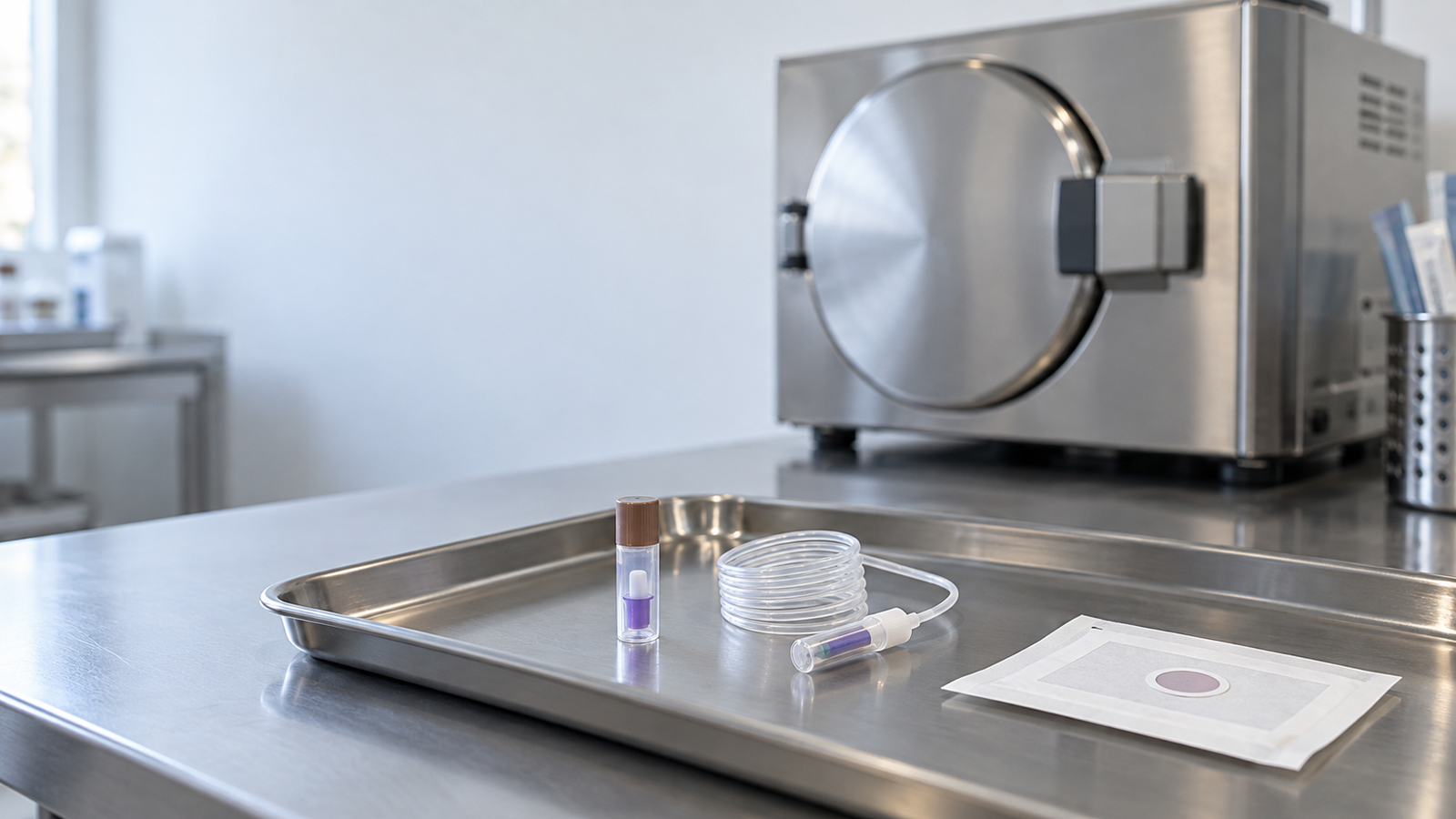
Why different checks are needed
Steam sterilisation depends on steam reaching every surface to be treated and on the parameters specified for the device, load and cycle. A value on the display, on its own, does not show that all conditions were met throughout the load. Monitoring therefore combines physical or mechanical information, chemical indicators and, as specified in the programme, biological indicators.
A piercing studio may have instruments with joints, cavities or lumens, as well as different packs and loads. Instrument compatibility with the cycle and how instruments are loaded must be established from the manufacturers' instructions and the studio protocol; they cannot be inferred simply from the label "Class B".
Bowie-Dick and Helix: checking air removal
The Bowie-Dick test assesses air removal and steam penetration under the test conditions specified for pre-vacuum sterilisers. When required for your steriliser, run it in an empty chamber before the first load on a day of use. The cycle, placement and compatibility must still be checked against the instructions from the equipment and test manufacturers.
An uneven result may indicate a problem with air removal or steam penetration. It does not identify the cause by itself and does not demonstrate the cycle's microbiological lethality. If the device indicates a failed or uncertain test, do not treat the result as a pass.
What is different about a Helix or another PCD?
A Helix is a process challenge device (PCD) with a defined challenge, often used to assess steam penetration through a hollow pathway. It is not simply another name for a Bowie-Dick pack: geometry, indicator, test cycle and interpretation depend on the model and steriliser. Use only the device and programme declared compatible in their respective manuals; do not substitute one test for the other by analogy.
Biological indicators: what they show
Steam biological indicators use spores resistant to moist heat, commonlyGeobacillus stearothermophilus, to challenge the process's microbiological efficacy under the conditions specified for that product. The biological test is one component of monitoring, alongside mechanical and chemical checks.
The result checks the processed indicator; it is not an absolute guarantee for every individual item and does not replace thorough cleaning, inspection, correct packaging, an appropriate load and a validated cycle. Batch, expiry date, transport, incubator and reading procedure can also affect interpretation.
Controls and incubation
For self-contained indicators, follow the manufacturer's instructions for activation, temperature and incubation time, reading, and validity of the positive control. These parameters are not universal: they differ between conventional and rapid-readout systems. Record the cycle and batch identifiers and retain the result documentation according to the local protocol.
If strips or indicators are sent to an external laboratory, follow the packaging, transport and interpretation instructions provided by the laboratory and test manufacturer.
Frequency: distinguish recommendations from local requirements
The required frequency depends on applicable legislation, regional or local health guidance, the autoclave manual, the quality programme and any association or certification requirements. It is not correct to present one frequency as a universal requirement for all piercing studios in Italy.
A monitoring plan should not automatically be inferred from a frequency used in a different setting. For your studio, check the applicable requirement with the relevant health authority and manufacturer, taking the autoclave manual and adopted quality protocol into account.
After maintenance, repair, relocation or an abnormal result, follow the verification procedure set by the manufacturer and technical lead: there is no standard sequence of cycles to improvise for every machine.
If a test fails or cannot be read
- Stop the release decision.Do not treat a failed, incomplete or uncertain test as a pass; identify and set aside the affected loads in accordance with the studio's written procedure.
- Record the facts.Note the test-device model, batch and expiry date, programme, cycle number, autoclave message and observed reading.
- Follow the non-conformance procedure.Involve the responsible person and, where indicated, an authorised service technician; apply the manufacturer's instructions and local health requirements to assess loads processed since the last valid check.
- Resume only after the required verification.Document the checks required by the manufacturer and protocol before returning the equipment to use.
Do not improvise a fault diagnosis or reuse material whose status has not been resolved under the protocol. For handling and disposal of biological indicators, including any positive vials, follow the manufacturer's instructions and local waste rules; do not assume that a generic treatment is appropriate.
A log that makes checks traceable
An orderly record helps identify trends and reconstruct a cycle. Depending on the system used, include the date and time, autoclave identifier, cycle number and programme, parameters or generated reports, test type, indicator batch and expiry date, result, operator, and actions taken if there is an abnormality. Retain sheets or reports and link the log to loads and packs according to the studio's traceability method.
Retention periods, mandatory fields and any link to client records should be checked against local rules and the professional system adopted; this guide does not present them as uniform national requirements.
Frequently asked questions
Does the Bowie-Dick test replace the biological test?
No. It checks aspects of air removal and steam penetration under the test conditions; it does not directly measure microbiological lethality.
Are Helix and Bowie-Dick interchangeable?
No. They are devices and tests with different challenges. Compatibility, cycle and correct use must be checked in the autoclave and test manuals.
Does a favourable biological result prove every instrument is sterile?
No. It should be interpreted as part of the process-monitoring programme and does not cancel out possible errors in cleaning, loading, packaging or the cycle.
Is monthly biological testing mandatory in Italy?
It is not correct to present a monthly interval as a universal national requirement. Check regional or local rules, the autoclave manual and the professional protocol applicable to your studio.
Sources and further reading
- CDC - Steam Sterilization: air removal, Bowie-Dick testing, biological indicators and monitoring of tabletop sterilisers.
- CDC - Summary Recommendations: monitoring recommendations for healthcare facilities.
- Association of Professional Piercers - Membership Requirements: association criteria for biological monitoring.
- Istituto Superiore di Sanità, EpiCentro - Italian regulatory framework: context for national circulars and regional provisions on tattooing and piercing.
- GKE/Mesa - Helix-PCD Testset, Instructions for Use: using the PCD to check sterilant penetration in hollow devices and the importance of test compatibility and sensitivity.
CDC recommendations refer to US healthcare facilities and are not automatically requirements for piercing studios in Italy. For technical standards, compatibility and cycle parameters, consult the applicable editions and the manuals for the products actually used.


