“Distilled”, “demineralised” and “reverse osmosis” are not interchangeable labels: they describe different treatments and do not, by themselves, guarantee a particular final water quality. For an autoclave, the decisive criterion is the water permitted by the manual for that specific model. For an ultrasonic cleaner and rinsing, follow the instructions for the equipment, detergent and applicable protocol.
In practice: use only the water specified by the autoclave manufacturer and check any stated conductivity or residue limits. Do not connect a domestic reverse-osmosis system with remineralisation without first checking compatibility. For cleaning and rinsing, do not attribute sterilising properties to distilled or RO water: ultrasonic cleaning does not sterilise.
1. The short answer: choose according to the equipment
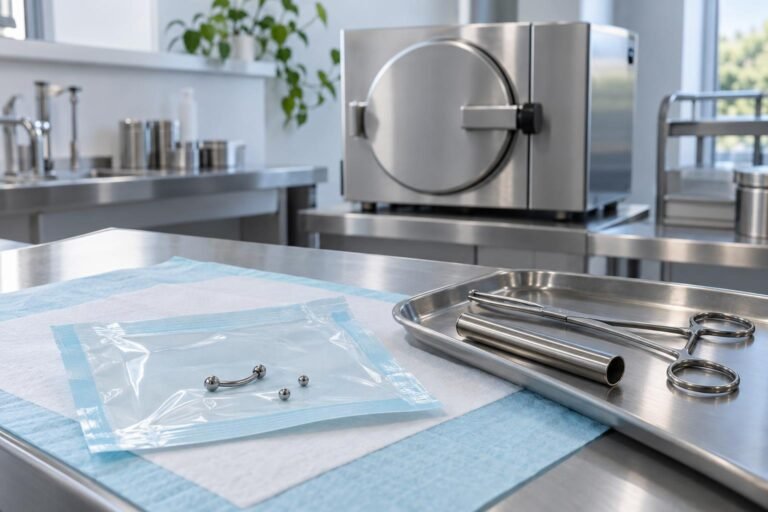
There is no answer that applies to every autoclave. Some manuals specify distilled water for steam processes and set their own limits for dissolved solids and conductivity. These figures apply only to the models and manual version concerned; they cannot automatically be applied to a different Class B autoclave or to a different autoclave model. Manufacturers may set different thresholds and monitoring methods.
For reusable instruments, cleaning is a separate stage from disinfection and sterilisation. Organic or inorganic residues may interfere with subsequent processes; instruments must therefore be cleaned before sterilisation in accordance with the specific instructions, applicable protocol and local requirements.
2. Distillation, reverse osmosis and deionisation
Distillation separates water by evaporation and condensation; reverse osmosis uses a membrane to reduce many dissolved substances. RO treatment is not, however, a guarantee of ultrapure water: the result depends on the incoming water, the system, the condition of the membrane and any subsequent stages. A system may include a remineralisation cartridge, so seeing “reverse osmosis” on a product is not enough to establish that the water is suitable for an autoclave.
Deionisation using resins further reduces ions, but “RO + DI” is not a universal certification either: maintenance, contamination and conditions of use affect the result. If the manufacturer specifies a measurable limit, check it with a suitable instrument and a method consistent with its instructions. A conductivity reading alone does not certify sterility, the absence of every contaminant or compliance with any particular standard.
| Label or system | What you can conclude | What you should not assume |
|---|---|---|
| Distilled water | It has been produced by distillation; some manufacturers may require it. | That every container meets every autoclave’s limit or remains unchanged after opening. |
| Reverse osmosis (RO) | Membrane treatment reduces many dissolved substances. | That the final product always has sufficiently low conductivity for any steriliser. |
| RO with post-treatment / DI | The configuration may produce water with different characteristics from RO alone. | That “ultrapure” or “medical” is substantiated without documented specifications and checks. |
| Commercially demineralised water | The label indicates a treatment, but not necessarily a uniform specification. | That it is suitable for an autoclave without checking the label, technical data sheet and manual. |
3. Autoclave: manual, water and maintenance
Before buying containers or installing a system, consult the section of the manual covering water quality, filling, any automatic feed and maintenance. Check at least:
- permitted water type and stated limits, including units and reference temperature;
- filling, storage and tank-management method;
- any integrated quality alarm or monitoring;
- maintenance interval and consumable components of the treatment system.
Integrated checks and stated limits vary from one device to another: a threshold quoted in a general article does not replace the up-to-date manual for your model. Healthcare guidance on water quality for reprocessing applies to specific categories of use and contexts; it does not allow every type of water or studio to be declared compliant.
If a system produces water for several uses, check the requirements separately: the autoclave, ultrasonic cleaner and rinsing may have different specifications. Document checks and replace filters or resins in accordance with the system manual; do not wait for stains or scale to signal a problem.
4. Ultrasonic cleaning and final rinsing
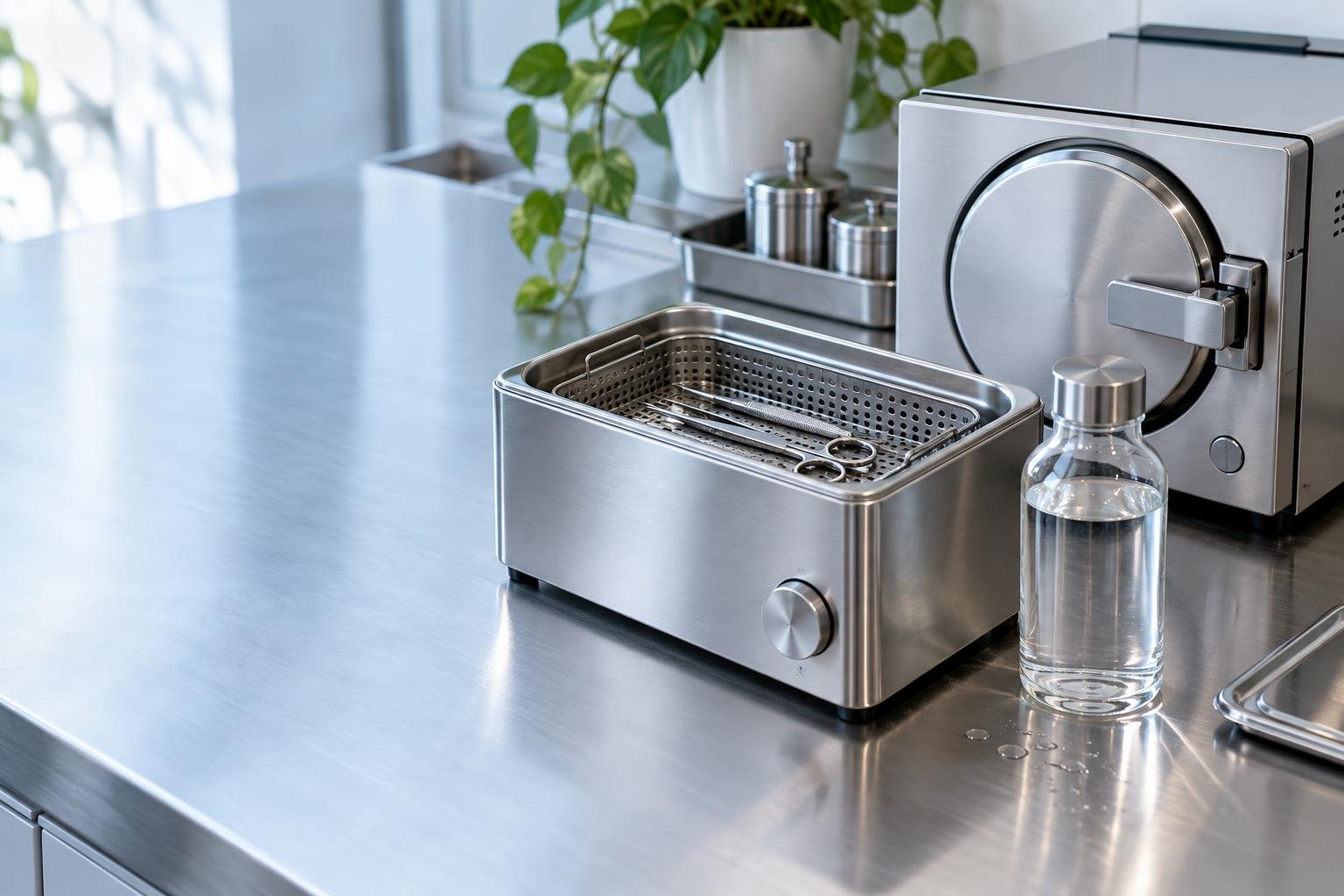
Ultrasonic cleaning removes residues by cavitation in an aqueous solution. It does not sterilise or automatically render the items treated sterile. The used bath may become contaminated: manage the bath and replace the solution in accordance with the instructions, the studio procedure and observed conditions, not according to a universal time interval.
When filling the tank and preparing the detergent, follow the instructions from the equipment and product manufacturers. Water hardness and composition may affect the process, but it is not accurate to say that RO water always improves the detergent or that distilled water is always necessary: check what the respective instructions specify.
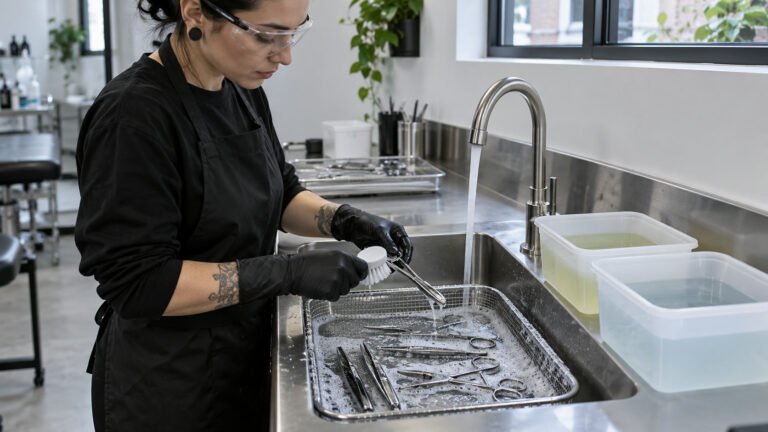
After cleaning, instruments should be rinsed to remove chemical or detergent residues, then dried and inspected before packaging where required by the process. The type of water and operational details depend on the instructions from the manufacturers of the instruments, detergents, washers and packaging materials: no universal requirement to use distilled or RO water can be inferred.
If the instrument, detergent or washer manual specifies a particular quality for the final rinse, follow that requirement. Do not, however, turn a protocol recommendation or a figure for a particular use into a universal requirement without checking its scope and applicability.
5. How to check water quality
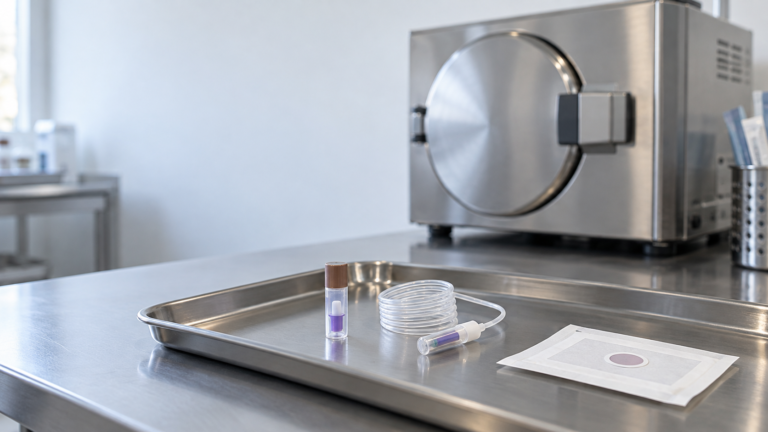
If the manufacturer specifies conductivity, use a suitable conductivity meter and follow the instructions for calibration, temperature and readings. Check that the instrument displays the required unit: µS/cm is not the same as ppm, and conversion between estimated TDS and conductivity depends on the factor selected. Record the date, sampling point, reading and action taken in accordance with the internal protocol.
A low reading is a monitoring result, not a complete test of microbiological or chemical quality. If a reading exceeds the manufacturer’s limit, stop and follow the procedure for that machine: do not compensate by switching to another type of water without confirmation. For RO/DI systems, plan checks and replacements according to the system specifications and measurement trends.
6. Mistakes to avoid
- Applying one threshold to every model: use the figures in the manual for that exact autoclave.
- Treating RO as synonymous with water suitable for sterilisation: check the configuration, post-treatment and result.
- Using remineralised water without checking it: the final composition may not meet the equipment requirement.
- Confusing ultrasonic cleaning with sterilisation: these are separate stages, and the latter requires a validated sterilisation cycle.
- Assuming distilled water is sterile or remains unchanged after opening: follow the storage instructions and do not infer quality from a label alone.
- Attributing unverified figures to a standard: cite a standard only when the relevant passage is available and its scope is clear.
7. Frequently asked questions
Can I use RO water in an autoclave?
Only if the manual for your specific model permits it and it meets the stated requirements. “RO” alone does not show that the water is compatible.
Is distilled water suitable for every steriliser?
Not necessarily. Some manuals require it, but always check the type and specifications required by the manufacturer of the equipment in use.
Do I need to use distilled water in an ultrasonic cleaner?
There is no general rule that applies to every piece of equipment and detergent. Follow the respective instructions and the studio’s validated procedure.
Does rinsing with purified water sterilise instruments?
No. Rinsing removes residues; it replaces neither proper cleaning nor the required sterilisation cycle.
Does a conductivity meter confirm that water is safe?
It confirms a conductivity reading under the measurement conditions; on its own, it does not certify every chemical or microbiological parameter.
Conclusion
To choose water, start with the up-to-date equipment manual, not a generic table. Distillation, RO and deionisation describe different treatments, but the process name alone does not guarantee compatibility. Keep the requirements for the autoclave, ultrasonic cleaner and rinsing separate; measure only the specified parameters and interpret each reading in context. If the instructions are unclear or the water falls outside the specifications, ask the manufacturer for confirmation before continuing to use the equipment.
For an overview of the complete process, also see the complete guide to autoclaves for body piercing.
Sources and limitations
- SciCan — STATIM 2000/5000 G4 Operator ManualWater quality section: an example of specifications and monitoring for identified models. Not generalisable to other sterilizers. Official manufacturer PDF, HTTP 200; the passage was extracted and checked locally. Consulted on 14 October 2026.
- Centers for Disease Control and Prevention (CDC) — CleaningSupports cleaning before sterilisation, ultrasonic cavitation, opening/disassembly to allow detergent contact, and caution regarding used solutions. General healthcare guidance, not a local rule specific to piercing studios. HTTP 200; consulted on 14 October 2026.
- CDC — Best Practices for Sterilization in Dental SettingsSupports rinsing after cleaning, drying/inspection and following manufacturers’ instructions. The page does not require distilled/RO water for every rinse and its context is dentistry. HTTP 200; consulted on 14 October 2026.
- CDC — Guidance for Healthcare Water System Repair and RecoveryDescribes categories and water-quality parameters for reprocessing medical devices in a specific healthcare context; it is not presented here as a universal requirement for every piercing studio. HTTP 200; consulted on 14 October 2026.
- CDC — Recommendations for Disinfection and Sterilization in Healthcare FacilitiesGeneral reference to the need to follow manufacturers’ instructions for reprocessing procedures and equipment. HTTP 200; consulted on 14 October 2026.
- U.S. Geological Survey (USGS) – DesalinationDescribes distillation as evaporation and condensation and explains reverse osmosis through a semipermeable membrane. A general reference on processes, not autoclave specifications. HTTP 200; consulted on 14 October 2026.
- USGS – Distilled/Deionized Water for District OperationsDescribes the use of ion-exchange resins and notes that the quality of purchased deionised water should not be assumed without checking. USGS technical note from 1992, relevant only to the general explanation of treatments. HTTP 200; consulted on 14 October 2026.
Editorial limitation: Numerical figures and regulatory claims in the source text concerning EN 13060, universal conductivity, distillation and RO have not been reproduced where they could not be verified against an accessible primary source or where their scope was unclear. This guide does not replace IFUs, full standards or local requirements.