
A bleeding piercing: what to look for
Seeing blood near a piercing can be alarming. Consider when it appeared, whether it is stopping, and whether there has been a knock or snag. A trace or small amount of bleeding immediately after the procedure can occur: piercing passes through vascularised tissue, and the amount may vary depending on the location and the person. However, there is no universal amount or duration that can, on its own, establish that everything is fine.
It is different if the bleeding continues, returns after stopping, begins some time after the procedure or follows an injury. Do not automatically attribute it to normal healing: there may be an injury or irritation that needs assessment, especially if there is a lot of blood or other symptoms appear.
This guide does not diagnose or replace an examination. If in doubt, contact a healthcare professional; piercers must recognise the limits of their competence.
Possible causes, without diagnosing
Blood may appear when tissue is stressed or injured. Possible mechanical causes include:
- a knock, snag or jewellery caught on clothing, towels, hair or bedding;
- repeated pressure or friction, for example when sleeping on the area;
- touching, twisting, forcing or unnecessarily moving the jewellery;
- swelling, or jewellery that seems to press, catch or leave too little room;
- an injury or a health condition/treatment that affects clotting.
These examples do not identify the cause in an individual case. Redness, swelling and pain can have several explanations; only a healthcare professional can assess an injury, infection or other condition. Blood accompanied by pus, pronounced warmth, increasing pain or feeling unwell calls for particular attention.
What to do cautiously straight away
- Wash your hands thoroughly before touching the area; use clean gauze if available.
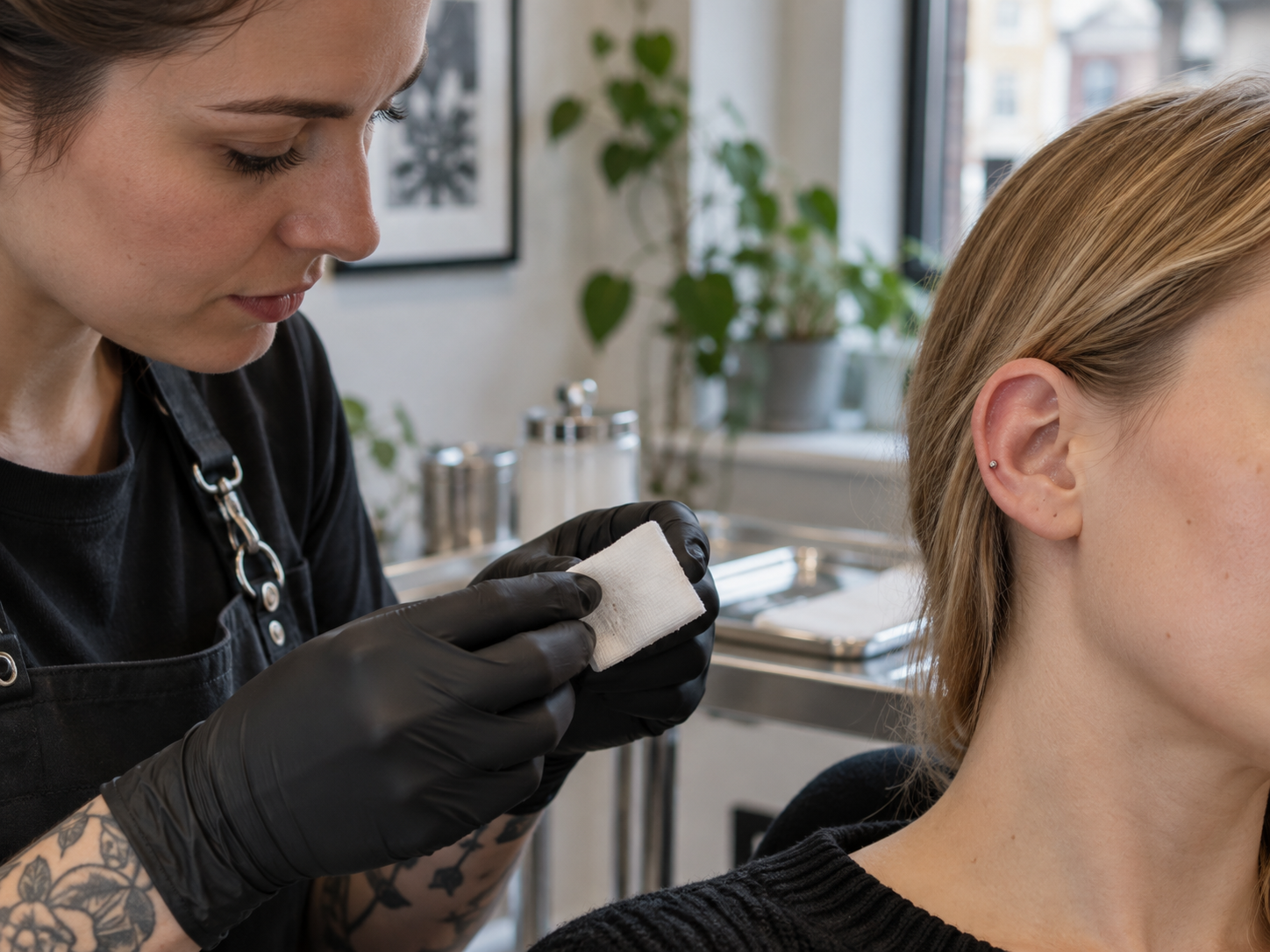
- Place clean gauze over the bleeding point and maintain firm, steady, direct pressure, without rubbing or moving or pushing the jewellery into the channel. If you cannot apply pressure without moving the jewellery, or if the bleeding is heavy or does not stop, seek help straight away.
- Do not unscrew, force or remove the jewellery yourself. Do not try to reinsert it if it has come out or shifted following an injury. Leave that decision to the healthcare professional assessing the situation.
- Once it stops, leave the area alone, avoid pressure and rubbing, and follow the care advice you have received. Do not apply alcohol, hydrogen peroxide, harsh disinfectants or ointments on your own initiative.
- If it persists or returns, contact a doctor or healthcare service. If the jewellery seems tight or embedded, do not try to loosen it by force.
General first-aid guidance recommends washing your hands and applying continuous direct pressure with clean material. If the jewellery is in place, keep it still: do not push it into the channel or try to remove or reposition it.
When to contact a doctor
Seek an assessment without delay if the bleeding persists or recurs, follows an injury, does not stop with continuous direct pressure, or the wound appears deep or significant. If you take anticoagulants or have a condition that affects clotting, seek medical advice straight away if bleeding occurs. Seek help even if you are unsure how serious it is.
Contact a doctor promptly if signs consistent with an infection appear, such as marked or increasing redness, swelling or pain, thick or foul-smelling discharge, fever, chills or general malaise. Do not decide on your own to remove the jewellery: leave it in place unless a doctor advises otherwise. A piercer is not a substitute for clinical assessment.
When it is an emergency
Call your local emergency service or go to the emergency department straight away if the bleeding is heavy or will not stop, spurts, the wound is large or deep, or the person becomes pale, weak, confused, very drowsy, dizzy or faints. Do not drive if you feel faint or are losing a lot of blood.
After a significant injury to the neck, chest, abdomen or groin, seek urgent assessment even if external bleeding appears limited. This warning concerns significant injuries, not a superficial piercing without trauma. In an emergency, do not wait for an online reply or a studio appointment.
Guidance for piercers and studios
Take the report seriously. Gather useful information: when it began, any knock or snag, whether it continues or recurs, and any reported general symptoms or relevant medication. Do not present mechanical possibilities as diagnoses or recommend invasive intervention on the jewellery.
If the bleeding is significant or persistent, there has been a serious injury, the jewellery is embedded, or the person feels unwell, refer them to healthcare services immediately. You can describe the jewellery and its placement to the doctor, but do not delay care or act as a substitute for a doctor.
Frequently asked questions
Is it normal for a new piercing to bleed?
A trace or small amount of bleeding immediately after the procedure can happen. There is no universal threshold for amount or duration: if it is heavy, does not stop, returns or occurs with symptoms, seek an assessment.
Why has it started bleeding again after a knock?
Snags, pulls or pressure can irritate or injure tissue, but the cause cannot be confirmed remotely. Do not move the jewellery; if the bleeding persists, is significant or recurs, contact a doctor.
Should I remove the jewellery while it is bleeding?
No: do not unscrew, force or remove it on your own initiative. If you suspect an infection, ask a doctor; leave it in place unless a doctor advises otherwise.
Can I use alcohol or hydrogen peroxide?
Do not apply them on your own initiative. Clean hands and firm, continuous direct pressure with clean gauze are a first-aid approach; then follow healthcare and aftercare advice.
Does bleeding mean infection?
Not necessarily: blood alone does not diagnose an infection. Increasing swelling or pain, warmth, pus, fever, chills or feeling unwell are reasons to consult a professional.
In brief
A small amount of bleeding immediately after the procedure can occur, but persistent or recurrent bleeding, or bleeding after an injury, should not be dismissed as a definite part of healing. Wash your hands, apply continuous direct pressure with clean gauze without moving the jewellery, and seek help if the bleeding is significant or persistent, signs of infection appear, or the wound is serious. Uncontrolled bleeding or severe illness is an emergency.
General information: this does not define diagnoses or numerical thresholds and does not replace a doctor or local emergency services.
Sources
Consulted on 14 October 2026. Wound-care guidance is general and does not replace an assessment specific to the piercing.
- Association of Professional Piercers – Body Piercing Troubleshooting: when to seek medical care, symptoms requiring attention and caution when handling jewellery.
- Association of Professional Piercers – Suggested Aftercare for Body Piercings: possible initial bleeding, clean hands, handling, and trauma/pressure.
- NHS – Cuts and grazes: direct pressure, severe bleeding and criteria for urgent care (last reviewed: 2 April 2026).
- MedlinePlus Medical Encyclopedia – Bleeding (U.S. National Library of Medicine / NIH): direct pressure, severe bleeding, anticoagulant medicines and major injuries (reviewed on 14 October 2025).
The sources do not establish a universal amount or duration for normal bleeding immediately after a piercing. Wound-care guidance is not a piercing-specific procedure: in the event of significant bleeding, injury or deterioration, healthcare assessment and local emergency services take precedence.