

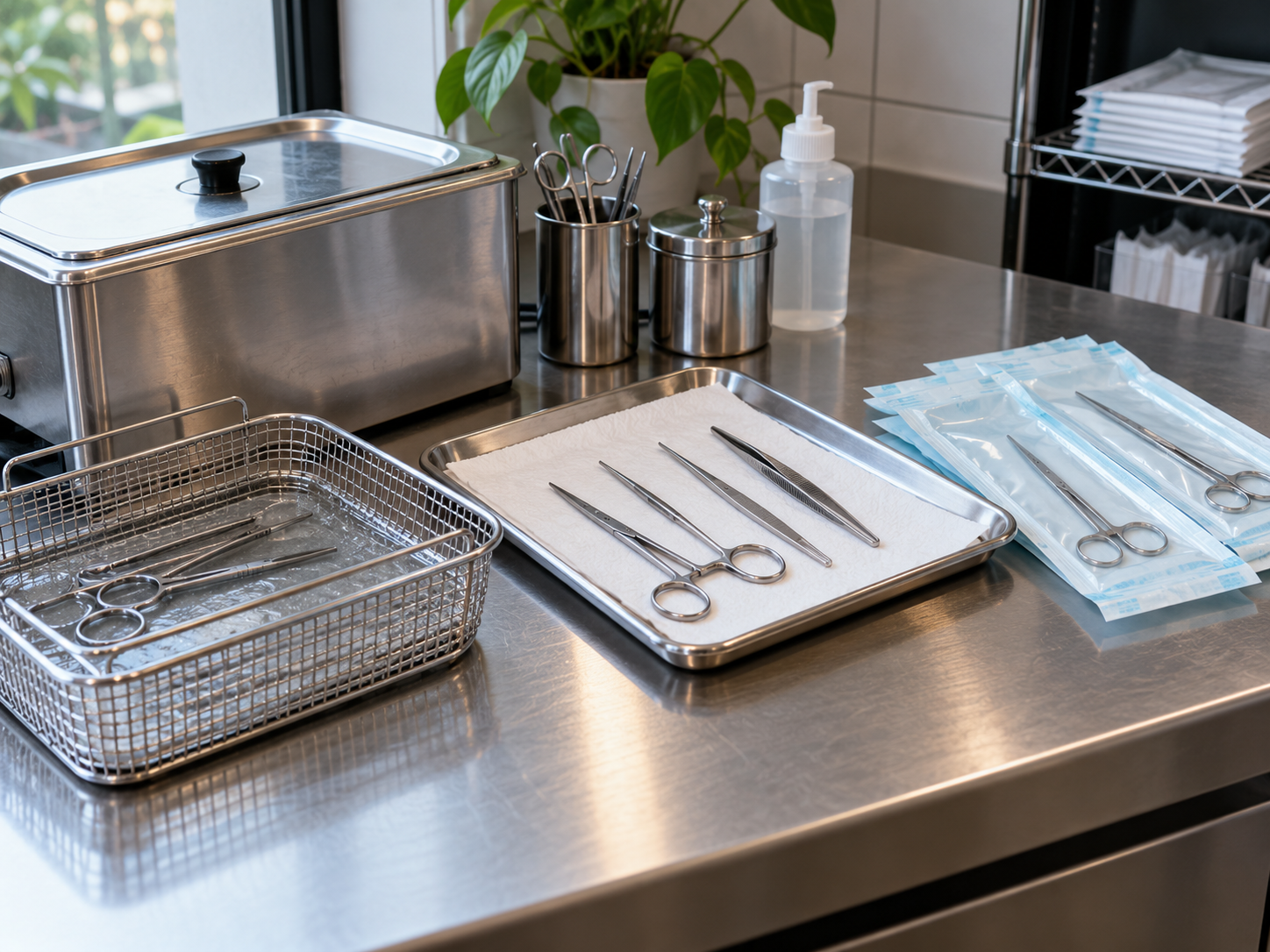
Three processes, three aims
In everyday language, these terms are often used as synonyms. In a studio protocol, they refer to different, non-interchangeable operations. The sequence depends on the item, its intended use and the manufacturer’s instructions.
Cleaning removes dirt and residues, including organic matter, through mechanical action and an appropriate detergent. It reduces material that could interfere with subsequent stages, but it is not the same as disinfection or sterilisation.
What disinfection does
Disinfection reduces or inactivates microorganisms, but its levels (low, intermediate and high) have different aims and are not equivalent to sterilisation. The outcome depends on the product, concentration, contact time, compatibility and intended use. A surface disinfectant does not make an instrument sterile and is not automatically suitable for skin.
For surfaces, first remove visible dirt, then apply the product according to its label and technical data sheet. Observe contact time and ventilation; do not mix products. Choose products in line with instructions and local rules.
What sterilisation means
Sterilisation is a controlled and validated process designed to destroy viable forms of microorganisms, including spores, according to a defined cycle and parameters. It is not a permanent guarantee: intact packaging, handling and storage protect the device until use.
For reusable instruments intended to penetrate tissue, the process includes thorough cleaning, inspection and drying in line with the manufacturer's instructions, suitable packaging, and a compatible sterilisation cycle with the required monitoring and records. Follow the IFUs for the instrument and steriliser, and check applicable rules.
Applying the distinctions to a workflow
Classify items according to their intended use and the manufacturer’s instructions: single-use, reusable, surfaces or equipment. Do not return single-use items to the routine reuse workflow; any reprocessing must be envisaged and validated under applicable rules. Keep dirty and clean areas separate, and protect processed devices from recontamination.
An enzymatic detergent, ultrasonic bath or disinfectant does not replace sterilisation when sterilisation is required. An autoclave cycle, in turn, does not remove residues or correct inadequate cleaning. If a cycle fails or packaging becomes wet or damaged, do not use the device: follow the specified handling and reprocessing procedure.
- Separate procedures for surfaces and instruments.
- Parameters, checks and records in accordance with the IFUs.
- Protected storage of processed materials.
Limitations and frequently asked questions
Definitions and obligations depend on intended use and applicable rules. This guide does not replace training, manufacturer instructions or directions from the competent authority.
- Does cleaning an instrument mean disinfecting it? No: they are different stages.
- Is high-level disinfection equivalent to sterilisation? No.
- Can an autoclave make up for incomplete cleaning? No.
Sources and limitations
These sources describe general principles of infection control and healthcare reprocessing; they do not validate a particular studio’s process or replace manufacturer instructions, training or local requirements. The cited FDA pages describe the US context and do not determine local obligations. Products, cycles, monitoring and requirements should be checked against the IFUs and applicable rules.
- CDC — Recommendations for Disinfection and Sterilization in Healthcare Facilities: principles of cleaning, disinfection and sterilisation.
- CDC — Cleaning: removing dirt and residues before subsequent processes.
- WHO — Decontamination and reprocessing of medical devices for health-care facilities: the general device reprocessing pathway.
- FDA — Reprocessing of Reusable Medical Devices: cleaning followed by disinfection or sterilisation in accordance with the instructions.
- FDA — Reprocessing Single-Use Medical Devices: reprocessing subject to a regulated and validated process in the US context.