
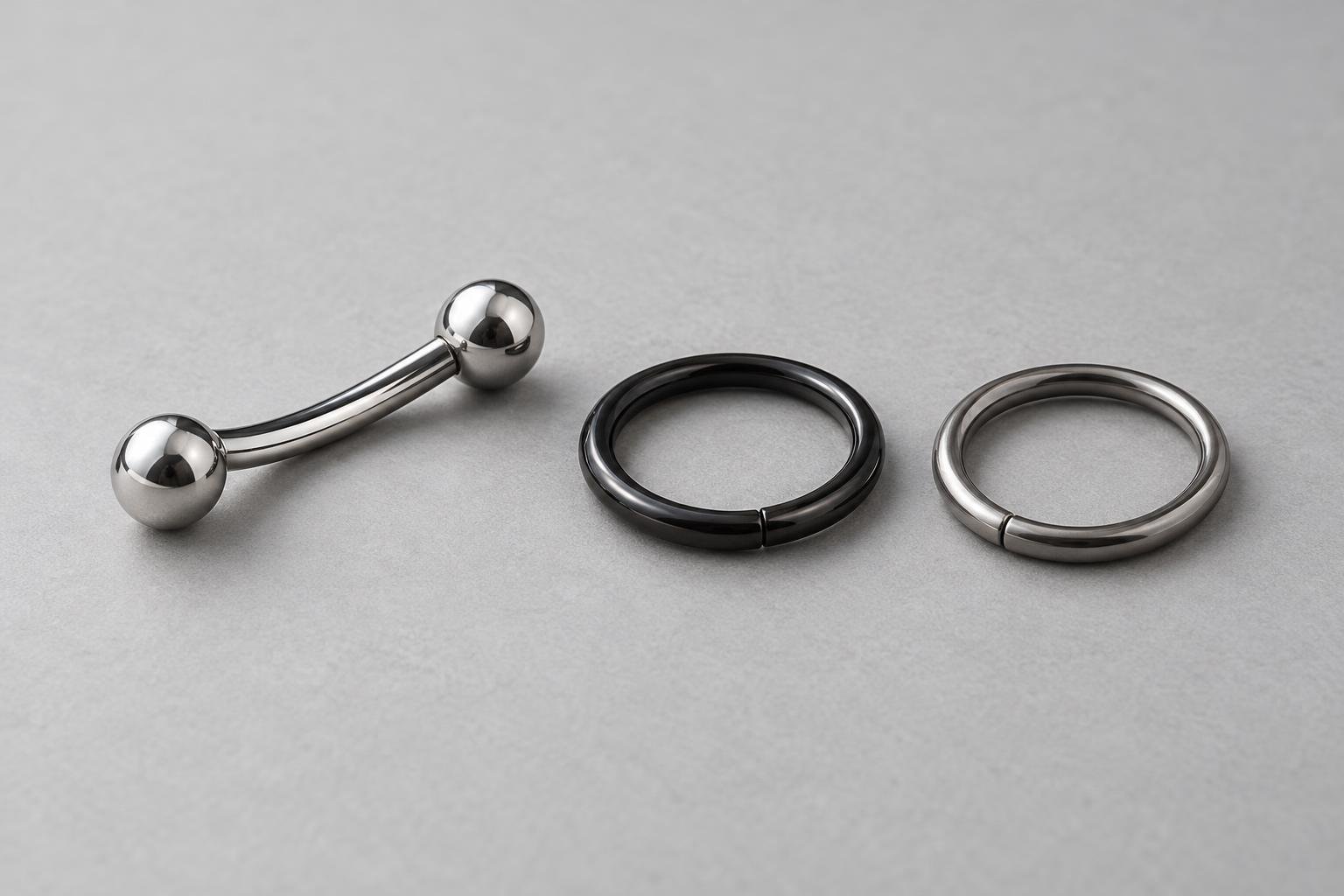
CoCr and niobium can have different uses in piercing jewellery. To compare them correctly it is necessary to distinguish the composition of the material, the shape of the semi-finished product, the finish of the jewellery and the batch documentation: an ASTM designation alone does not certify every stage of manufacture or the individual finished item.
Cobalt-chromium alloys: what do F75 and F1537 identify?
CoCr alloys are also used in the biomedical and dental fields, where they can be selected for their mechanical properties and resistance to corrosion. The actual properties depend on the specific alloy, shape, treatment and finish.
Two different specifications, two product forms
- ASTM F75 covers castable cobalt-chromium-molybdenum alloys for surgical implant applications. The specification deals with unfinished castings and casting alloy: it is not an automatic certification of the jewellery after casting, processing and polishing.
- ASTM F1537 covers wrought Co-28Cr-6Mo alloys; the specification specifically covers bars, rods and wires intended for the production of surgical implants. It is not simply an interchangeable version of F75.
Chromium contributes to the formation of a passive surface film that limits corrosion. However, this metallurgical principle does not demonstrate zero release of ions in all conditions, nor does it replace the analysis of the batch composition or the verification of the finished product.
Polished CoCr typically has a light metallic appearance and can offer greater stiffness than more ductile metals. It is not correct to transform these characteristics into absolute promises of scratch resistance or reduced biofilm formation: alloy, finish, geometry and use matter. Rings that require hand twisting may be impractical in a rigid alloy; compatibility must be assessed for the specific model and manufacturing process.
Another distinct alloy is that covered by ASTM F90, identified by ASTM itself as Co-20Cr-15W-10Ni. The name indicates a significant amount of nickel in the nominal composition: it should not be described as nickel-free or confused with F75/F1537. Any suitability depends on the jewellery, documentation and applicable requirements.
Niobium and ASTM B392: Grades, Shapes, and Processing
Niobium is a metallic element, but ASTM B392 includes both unalloyed niobium grades and niobium-zirconium alloy grades. The B392-26 standard applies to worked bars, rods and wires. It is therefore not enough to read "ASTM B392": you need to check the UNS designation and the material certificate.
- R04200, Type 1: unalloyed niobium, reactor grade.
- R04210, Type 2: unalloyed niobium, commercial grade.
- R04251, Type 3: niobium alloy with 1% zirconium, reactor grade.
- R04261, Type 4: niobium alloy with 1% zirconium, commercial grade.
Purity values should not be deduced from the trade name or type alone: the specification establishes chemical and mechanical requirements and the certificate must refer to the batch and form of raw material used. For jewellery declared to be made of unalloyed niobium, check that the documented grade is indeed R04200 or R04210.
Niobium is more ductile than many CoCr alloys and is suitable for making rings that are opened or closed by twisting. However, the ease of processing and the spring-back depend on the diameter, state of the material, geometry and technique: there is no "perfect" closure guaranteed by the name of the metal alone.
Anodisation, black colour and surface quality
Niobium can be anodised to obtain colours due to the interaction of light with the surface layer; colour is not proof of the composition or quality of the jewellery. Black niobium is also available, but the colouring method and finish should be verified with the manufacturer. For jewellery intended for a new piercing, niobium alone is not enough: the surface must be smooth, well finished and suitable for sterilisation. Rough or matte black finishes should not be equated with a shiny, smooth black surface.
Ductility can make threads and mechanical couplings more delicate, but it does not follow that every threaded niobium piece is impractical or destined to strip. Evaluate the actual design/construction and manufacturer's recommendations; for bars and labrets, some systems use different components or mechanisms.
Practical comparison of CoCr, niobium and titanium
| Appearance | CoCr (F75 / F1537) | Niobium (B392) | Titanium (e.g. F136) |
|---|---|---|---|
| What does the standard describe | Alloy for implant applications; F75 castable, F1537 wrought | Bars, rods and wires in niobium or Nb-Zr alloy; check UNS and shape | Ti-6Al-4V ELI alloy for implant applications |
| Ductility and forming | Typically stiffer; machining depends on grade and process | Ductile; behaviour dependent on shape, diameter and condition | Properties dependent on alloy and shape |
| Nickel | Do not declare it “nickel-free” on the sole basis of F75/F1537; check certificate | Unalloyed grades have no nickel as an alloying element; however, check the documented composition | The F136 alloy is not a nickel alloy; check product specification |
| Colour | Light metallic appearance; colour and polish depend on finish | Coloured anodising; can also be produced in black with suitable finish | Coloured anodising; do not deduce suitability from the colour |
| Weight for the same volume | Generally high; the value depends on the exact alloy | Approximately 8.60 g/cm³ for R04200 Type 1 niobium according to the cited technical data sheet | Lower than niobium for Ti-6Al-4V ELI |
| What the standard does not prove | The material code alone does not certify the finished jewellery, the traceability of the piece, the finish or compliance with REACH. | ||
Nickel and REACH: what can be concluded
Annex XVII, entry 27 of the REACH regulation limits the release of nickel, among other cases, to 0.2 µg/cm²/week for post assemblies inserted into pierced ears and other pierced sites on the body. The threshold concerns release under expected conditions, not the total percentage of nickel in the alloy. The EN 1811 standard is the reference method for determining the release; the applicable framework must be verified on the updated regulatory text and on the type of article.
REACH compliance cannot be inferred from whether an alloy contains chromium, develops a passive layer or unalloyed niobium has no nickel as an intentional component. The composition, processing and surface of the finished product matter. Even the statement “automatically passes the test” requires adequate evidence or documentation: a chemical certificate of the raw material is not, in itself, a release test for the finished jewellery.
How to assess piercing jewellery and its documentation
- Ask for the complete designation of the standard, the UNS grade, the shape of the semi-finished product and the certificate linked to the lot. Per ASTM B392, distinguish unalloyed niobium from Nb-Zr alloys.
- Verify that the certificate's traceability extends to the material actually used for the jewellery; a generic document does not automatically demonstrate the provenance of the individual piece.
- Separately evaluate polishing, edges, threads or a threadless system, geometry and possibility of cleaning and sterilisation. Material compliance does not replace manufacturing control.
- For a recent piercing, consider together documented material, smooth finish, appropriate size and style, and compatibility with the sterilisation process. Don't choose just based on colour, hardness or commercial code.
- For European conformity declarations, ask for the documentation relating to the product and the specific requirement. The mere name of a metallurgical standard is not a general statement of REACH compliance.
Sources
Accessed October 14, 2026. Complete ASTM standards may require access to the full text; public summaries identify the scope and form of the product; they do not replace the complete specification or batch certificate.
- ASTM International, ASTM F75-23 — Cobalt-28 Chromium-6 Molybdenum Alloy Castings and Casting Alloy for Surgical Implants.
- ASTM International, ASTM F1537-20 — Wrought Cobalt-28Chromium-6Molybdenum Alloys for Surgical Implants.
- ASTM International, ASTM F90-23 — Wrought Cobalt-20Chromium-15Tungsten-10Nickel Alloy.
- ASTM International, ASTM B392-26 — Niobium and Niobium Alloy Bar, Rod, and Wire.
- Association of Professional Piercers, Jewellery for Initial Piercings — general materials, finish and jewellery criteria for recent piercings.
- Association of Professional Piercers, Mill Certificate Criteria — function and traceability of the raw material certificate.
- Regulation (EC) n. 1907/2006 (REACH), consolidated text as of 1 September 2025, Annex XVII, entry 27 — nickel.
- BSI, BS EN 1811:2011+A1:2015 — reference test method for nickel release.
- Fort Wayne Metals, Niobium — physical and mechanical data for R04200 Type 1.