

Why does jewellery material matter?
Choosing jewellery material is an important part of supporting safety, comfort and healing. Pieces that look similar may differ in how the body responds, how they wear and how they look over time.
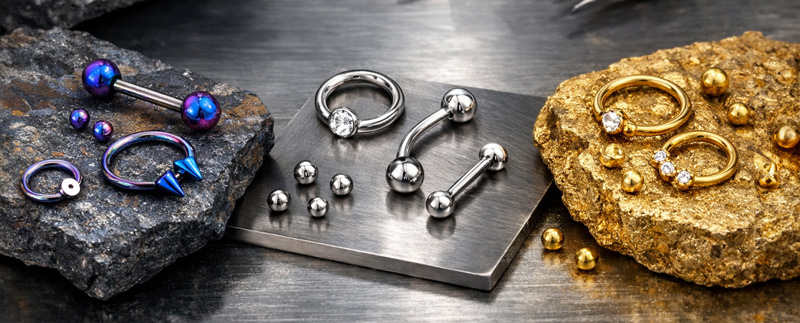
Common options include titanium, surgical steel and gold—each with properties that may make it more or less suitable depending on the individual and the stage of the piercing.
Titanium
Titanium is often chosen for fresh piercings because it is lightweight and can be biocompatible when the alloy, finish and design are appropriate. The term “implant-grade titanium” is not enough on its own: check for a documented specification, such as ASTM F136, ASTM F67, ASTM F1295 or ISO 5832-3, and request material documentation.
It is not accurate to promise that every titanium piece is nickel-free. This depends on the documented composition, workmanship and finish of the specific item. Anyone with nickel sensitivity should discuss the choice with a piercer and check the manufacturer’s documentation.
Implant-grade titanium is corrosion-resistant and can be anodised to produce different colours. The suitability of any finished piece still depends on its documented material and workmanship.
For many initial piercings, piercers prefer titanium that conforms to a relevant standard, has a smooth surface and is supported by batch documentation. This is a technical preference subject to the quality of the finished piece—not an absolute guarantee or a substitute for individual assessment.
Surgical steel
Surgical steel is widely used in piercing jewellery and is often valued for durability and affordability. The finish and performance depend on the specific grade and finished item.
However, “surgical steel” is a broad commercial label. Documentation for a specific grade—such as one conforming to ASTM F138 or ISO 5832-1, together with relevant biological evaluation or European nickel-release requirements—may help assess suitability. A generic label does not establish composition.
It is not accurate to reserve all steel jewellery automatically for healed piercings. The decision depends on grade, finish, design and documentation. If that information is unavailable, do not describe the piece as suitable for a fresh piercing.
Gold
Gold may be considered for an initial piercing only when it is solid, at least 14k, free of nickel and cadmium, and alloyed for biocompatibility. Gold above 18k is softer; plated, gold-filled, vermeil or adhesive-set jewellery is not equivalent to solid gold.
Gold tolerance depends on alloy composition and surface quality. Knowing the carat value alone is not enough: ask for the composition and manufacturer’s documentation, especially where there is metal sensitivity.
Depending on the alloy, other elements may affect skin tolerance.
Gold offers a distinctive finish and is often chosen for healed piercings or higher-end jewellery. Suitability depends on the specific alloy and finish.
Bioplex
Bioplex is a product or product-family name. Check the product specification and manufacturer’s instructions for composition, sterilisation methods and intended use. Do not assume that it contains no metals or is suitable for an initial piercing.
A non-metallic material is not automatically compatible with MRI or autoclave use. For an MRI examination, follow the healthcare provider’s assessment and instructions; do not decide whether to remove or keep jewellery based on a general rule.
Consider Bioplex only when the specific product, its intended use and its sterilisation method are documented by the manufacturer and appropriate to the circumstances. It is not automatically a substitute for documented implant-grade material in an initial piercing.
Cobalt chromium
Cobalt-chromium is a family of alloys with differing properties. Assessing it for piercing jewellery requires information on composition, applicable standards, finish, biological evaluation and intended use; describing it as durable or medical-grade is not enough.
Passivation may contribute to corrosion resistance, but it does not by itself establish the biocompatibility of finished jewellery. For an initial piercing, do not present cobalt-chromium as equivalent to compliant titanium without product-specific documentation.
Cobalt-chromium may be used for specific body-jewellery applications, but it is less common than titanium.
Conclusion
Different materials may suit different needs, but a material name alone is not enough to judge safety. Grade, finish, design, workmanship, documentation and compatibility with the sterilisation process all matter.
Consider the stage of healing, anatomy, individual sensitivities, jewellery quality and available documentation. For a fresh piercing, prefer material and finish that can be verified against a relevant standard, and seek a piercer’s assessment.
Sources and limitations
A commercial material name alone does not establish biocompatibility. For jewellery intended for a fresh piercing, check the material, grade or standard, finish, design, batch documentation and sterilisation compatibility. Decisions about MRI should be made with the healthcare provider, taking the specific device and examination into account.
- Association of Professional Piercers — Jewellery for Initial Piercings — accepted grades of titanium, steel, gold and glass, and finish and threading requirements
- ASTM F136 — specification for Ti-6Al-4V ELI titanium alloy for surgical implant applications
- ISO 5832-3 — titanium alloy for surgical implants
- FDA — ISO 10993-1 — risk-based biological evaluation of medical devices
- EUR-Lex — REACH, nickel release — European limits on nickel release from products in prolonged contact with the skin
Sources consulted on 27 September 2026. These sources do not replace material certification or the manufacturer’s instructions.