

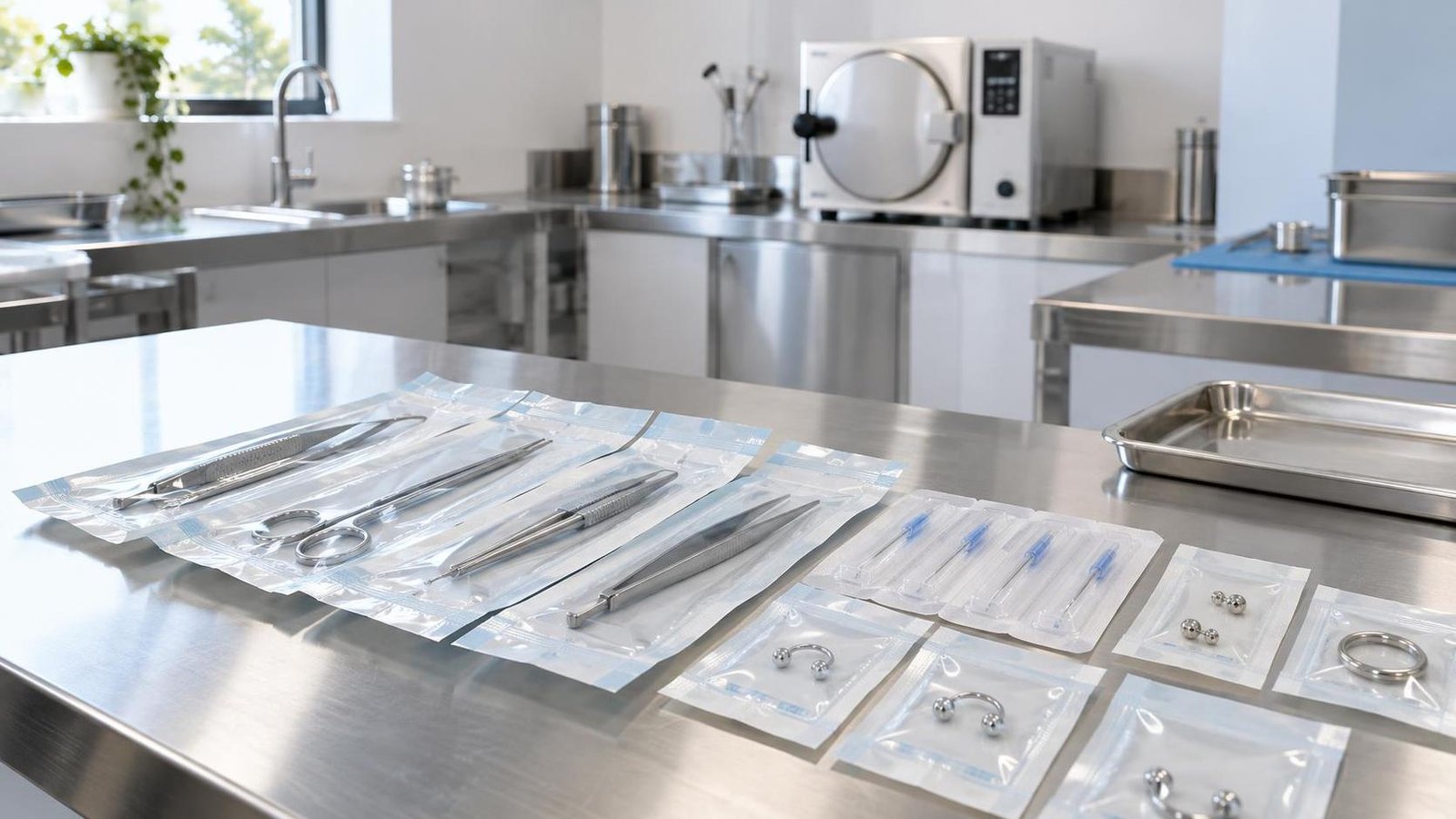
Managing hygiene in a body-piercing studio involves more than keeping surfaces clean: you need to be able to describe how the station is prepared, how clean items are kept separate from contaminated ones, how reusable instruments are handled and how each step is documented. The difficulty is that, in Italy, some operating conditions depend on regional or local laws and measures. A generic checklist therefore cannot replace checking the requirements that apply in the municipality and region where you work.
Guiding principle: build procedures that can be checked against the specific studio, linking them to official local sources and the manufacturer's instructions. Do not turn professional recommendations into legal requirements or copy sterilisation parameters without checking that they are compatible.
1. Before using a national checklist
The 1998 Ministry documents on tattooing and piercing are historical public-health references. Citing them alone does not show that every detail in a checklist is now a uniform requirement in every region. The applicable rules may be supplemented by regional laws, implementing measures, municipal regulations and guidance from the competent health authority. Check the version, territory, effective date and scope of each measure before describing something as "mandatory".
Legislative Decree No. 81/2008 concerns health and safety at work, while Presidential Decree No. 254/2003 governs healthcare waste within its scope. Their existence is not enough to infer automatic requirements for room dimensions, training hours, testing frequency or the classification of every item of waste produced by a studio. Such conclusions require a specific check of the current legislation and the studio's circumstances.
In this guide, requirement means a condition that must be linked to an applicable current source; good practice means a useful organisational measure, not presented here as a general legal requirement; manufacturer's instructions means what is specified for the particular product, instrument or equipment. This distinction should remain clear in the internal manual.
2. How to build the applicable regulatory framework
Before drafting the SOPs, prepare a regulatory matrix containing at least: source and official link; relevant article or section; territory; persons and activities covered; version or update date; operational requirement; and the person responsible for checking it. Keep national, regional and municipal sources separate, and note any points that need clarification from the ASL/ATS (local health authority) or a qualified adviser.
| Scope | Reference to check | Prudent use in the manual |
|---|---|---|
| Tattooing and piercing | Ministry guidance and current regional/local rules. | Record which parts apply to the studio and any additional requirements set by the local authority. |
| Health and safety at work | Legislative Decree No. 81/2008 and applicable implementing provisions. | Link the risk assessment to the actual tasks and products used; do not infer specific requirements without checking. |
| Healthcare waste | Presidential Decree No. 254/2003 and relevant current environmental rules. | Define segregation, containers, storage, collection and records according to the applicable classification. |
| Products and devices | Applicable EU and national rules; manufacturers' labels and instructions for use. | Keep identifying documentation and do not infer conformity or suitability from a trade name alone. |
The matrix is a control tool, not legal advice. If a source is ambiguous, the regional rules have changed or the municipality applies specific requirements, record the question and obtain confirmation from the competent authority before stating that the premises comply.
3. Premises and workflows: plan around the activities
The layout should reduce crossings between clean preparation, carrying out the procedure and handling used instruments. Before settling on an arrangement, compare the floor plan with the applicable regional and municipal requirements: this guide does not set a universal minimum area for treatment rooms or prescribe an architectural solution for every studio.
Work station
Document how surfaces are cleared and treated between clients, which single-use barriers are used, which surface products are authorised, and their contact time according to the label. Keep clean/sterile materials separate from personal items, outer packaging and used materials. Prepare a sharps container in advance and keep it accessible without reaching across the work area.
Reprocessing area
If the studio processes contaminated reusable instruments, describe and maintain the route from receipt of dirty instruments through cleaning, inspection, packaging and sterilisation, avoiding any return towards the clean area. It is useful to distinguish point-of-use steam sterilisation of new, clean items from reprocessing reusable instruments exposed to blood or other potentially infectious material. This technical distinction does not by itself determine the structural requirements that apply in Italy; these must be checked locally.
If the layout or type of work does not allow clear separation, do not try to solve the problem with labels or colours alone: review the physical workflow with the competent authority and adapt the process.
4. Operating procedures to document
An SOP is useful when it enables different operators to carry out the same task consistently and understand what to do if something goes wrong. Each procedure should state: purpose and scope; person responsible; materials and products; sequence of actions; precautions and PPE; records; error handling; version and review date.
SOP A - Reception and preliminary assessment
- Describe how identity and age are checked under the rules that actually apply in the relevant area and to the procedure requested.
- Define how the information needed for the consultation is collected and stored. Limit it to what is necessary, inform the client and separately check data-protection obligations, especially when health information is collected.
- Document the jewellery and materials selected using information provided by the manufacturer, and retain batch details when available and relevant.
- Explain the procedure, known risks, aftercare and the option to postpone the service; record consent under the studio's process and local requirements.
SOP B - Preparing the station and treatment field
- Specify the product, surface, dilution if applicable, contact time and PPE according to the label and manufacturer's instructions.
- Apply barriers to the selected surfaces and lay out only the items needed.
- Open sterile packs using a technique that maintains the integrity of the field; if a pack is damp, torn or open, do not treat it as sterile and follow the rejection procedure.
- Define when gloves should be changed and how to prevent non-sterile objects from contacting the prepared field.
SOP C - Operator hygiene and procedure
- Specify hand hygiene, PPE, management of splashes/exposures and when gloves are changed, in line with the risk assessment and applicable guidance.
- Describe skin or mucosal antisepsis only with products authorised for that site, following their instructions; do not prescribe universal concentrations or timings.
- Provide for single-use materials for each client and sterile, single-use needles. Do not present a professional preference about technique as a legal requirement without a current Italian source.
- Dispose of the used needle immediately in a suitable container, without recapping it, in line with the risk assessment and the studio's sharps procedure.
SOP D - Closing the station and cleaning
- Describe the controlled removal of barriers, segregation of single-use items, surface treatment and glove changes between incompatible tasks.
- Transfer reusable instruments in a closed, robust container, following the planned route to the dirty area.
- Restock the station and record any incidents, compromised packs, faults or deviations from the process.
5. Cleaning and sterilisation: distinct processes to validate
Cleaning removes foreign material and organic residues; it must take place before high-level disinfection or sterilisation because residues can interfere with these processes. The CDC describes opening hinged instruments, disassembling them as far as possible and loading them so the solution can make contact. It also notes that cavitation in an ultrasonic bath removes debris but must not be confused with sterilisation; used cleaning solutions can become contaminated.
For a practical overview of steam sterilisation in body piercing, also see the complete autoclave guide.
For each instrument and detergent, follow the instructions for use on compatibility, pre-treatment, concentration, temperature, contact time, rinsing and drying. Avoid standard recipes copied from other studios or from different equipment models. If you cannot establish a suitable, validated cycle, do not improvise: ask the manufacturer or the person responsible for the process.
Steam sterilisation requires suitable equipment, maintenance and a cycle appropriate to the load and the manufacturer's instructions. Do not put a temperature, pressure and duration combination in the SOP without reference to the machine manual or validation. Record the information required by the procedure for each cycle, and follow the device instructions if there are alarms, damaged packs or wet loads.
Periodic biological monitoring may be included as a technical check, subject to applicable requirements and the device instructions. Do not present frequencies or methods as a universal Italian requirement without an applicable source and without considering the device manual.
6. Traceability and records without excessive data collection
Keep records consistent with the actual processes, for example to identify instruments and cycles, note maintenance and checks, trace batches of products used and document deviations. Decide who completes and who checks each record, and how errors are corrected without erasing the original audit trail.
Recording client data must not become indiscriminate collection of health information. Define the purpose, access, retention periods and privacy notice under data-protection law, and seek qualified review of the legal bases and health data. Consent to the procedure and privacy management are separate processes; this guide does not determine which legal basis applies to an individual studio.
Make records readily available to authorised staff, but store them so clients and visitors cannot access the data. The specific arrangements, paper or digital, should reflect the risks and applicable rules.
7. Sharps and waste: classify before disposal
Presidential Decree No. 254/2003 governs healthcare waste within its scope, but correct classification depends on the waste's origin and characteristics. Do not automatically assign a European Waste Catalogue (EWC) code to every glove, gauze or barrier used in a studio without checking the definitions, current environmental rules and authorised collection route.
The SOP should specify the containers used, where they are placed, the maximum fill level according to their specifications, closure, temporary storage and collection. Put used needles in a rigid sharps container and replace it in line with the manufacturer's instructions before it is overfilled. Also define what to do after accidental needlestick injuries or spills, whom to notify and which records to complete.
Agree the classification and disposal route with the authorised waste contractor and the relevant adviser; keep the required documents. The aim is a controlled workflow, not a single label copied from another business.
8. Tailoring and keeping SOPs up to date
- Inventory actual activities: the piercings performed, reusable instruments, products, equipment and waste streams.
- Check local sources: collect current regional and municipal measures and guidance from the competent health authority.
- Collect IFUs: keep current instructions for the steriliser, detergents, disinfectants, devices and materials.
- Write the sequences: assign roles, actions, records and exceptions; distinguish regulatory requirements from good-practice choices.
- Train staff: explain the procedures, check understanding and record any required training.
- Review: update the SOP after changes to products, equipment, premises, processes or legislation, and after significant incidents or deviations.
A procedure is not up to date merely because it has a recent date: it must match the equipment in the studio, current instructions and applicable local rules.
9. Frequently asked questions
Is there one identical SOP that applies to every studio in Italy?
No. A common framework helps organise work, but regional and municipal requirements and studio processes may differ. The final procedure must be tailored and checked locally.
Do I always need a separate room for sterilisation?
It is not possible to give a universal answer here. It depends on the activities carried out, the instruments processed and local requirements.
Can I specify a cycle of 134 °C for five minutes in the procedure?
Not without checking. Parameters depend on the equipment, load, packaging, instructions and required validation. Copying one isolated value does not demonstrate that your cycle is suitable.
Is all contaminated waste EWC 18 01 03*?
Do not assign the code automatically. Check the definition that applies to the type and origin of the waste, current environmental rules and the authorised disposal route.
Does consent to piercing also cover the health data collected?
Do not assume they are the same thing. Separate information and consent relating to the procedure from the privacy assessment; check the applicable legal bases and conditions with a qualified professional.
Conclusion
The strongest SOPs are not those with the most numbers or abbreviations: they are the ones that link each activity to the right source, describe the workflow actually followed and explain how to identify and manage a deviation. For a studio in Italy, this requires checking regional and municipal provisions, manufacturers' instructions, and safety and disposal responsibilities. Professional guidance can help organise the work, but it does not replace local law or validation of the process.
Sources and limitations
- Ministry of Health - technical publication citing the circulars of 5 February and 16 July 1998 on tattooing and piercingOfficial document consulted as a historical reference; not used to attribute detailed or current requirements uniformly across all regions. Consulted on 14 October 2026.
- Normattiva - Legislative Decree of 9 April 2008, No. 81Official text consulted to identify the national reference on health and safety at work; its application to an individual studio is not assessed in this guide. Consulted on 14 October 2026.
- Normattiva - Presidential Decree of 15 July 2003, No. 254Official text consulted for the general scope of healthcare-waste rules; classifying individual studio waste requires a specific check. Consulted on 14 October 2026.
- Association of Professional Piercers - 2025 APP Stance on Point of Use Steam SterilizationThe association's professional position on the distinction between point-of-use sterilisation and reprocessing contaminated reusable instruments; it is not Italian law. Consulted on 14 October 2026.
- Association of Professional Piercers - Picking Your PiercerClient-facing professional material referring to hygiene, single-use needles and sterilisation. It is not a source of Italian legislation. Consulted on 14 October 2026.
- Centers for Disease Control and Prevention - Cleaning, Guideline for Disinfection and Sterilization in Healthcare FacilitiesGeneral health guidance on the role of cleaning before sterilisation, pre-treatment, loading and ultrasonic cleaning. It does not specify legal requirements for piercing studios in Italy. Consulted on 14 October 2026.
Checks completed on 14 October 2026. This guide is for information and is not legal advice, a risk assessment or validation of a sterilisation process. Local requirements and instructions for products and devices in use must be checked before adoption.