

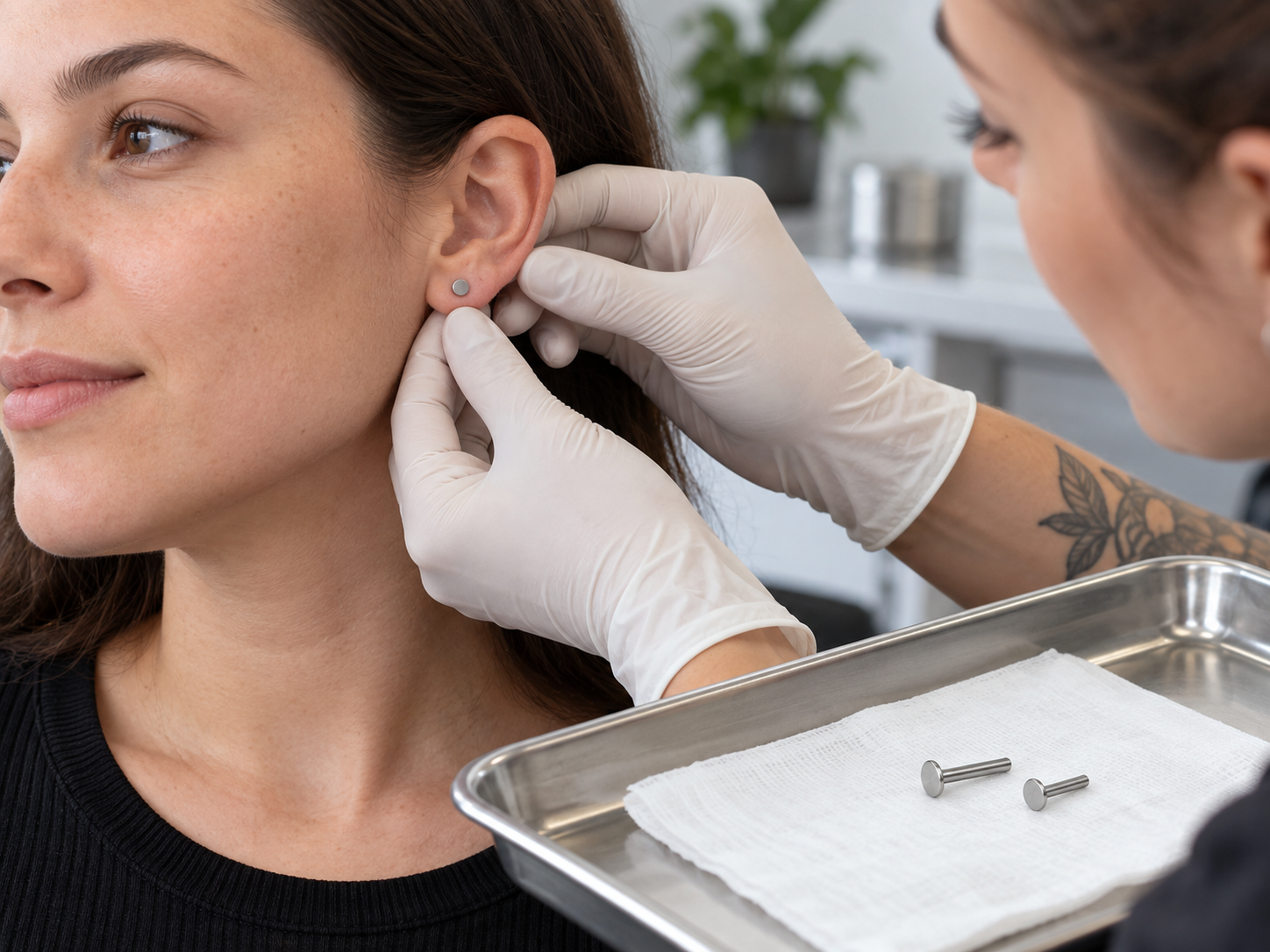
What is piercing downsizing?
The term "downsizing" means replacing the initial jewellery with a shorter piece once the initial swelling has gone down and the extra length is no longer needed. The term describes a functional adjustment to the fit; it does not guarantee that the piercing has healed and is not, in itself, a style change. It is best to return to your piercer to assess and fit the right size: the first replacement may take place while the channel is still healing, so it is not the time for a DIY change.
Many piercings are initially fitted with extra room because tissue may swell. As the swelling goes down, the post or barbell may protrude more than necessary. Shortening it, when appropriate, can help limit knocks and repeated movement. This does not mean automatically choosing the shortest barbell available: anatomy, placement, jewellery design and the current condition of the tissue all need to be considered together.
When to consider downsizing
There is no universal timeframe that applies to everyone. Swelling and healing vary between people and piercing sites; a calm appearance on the outside does not, by itself, show that the channel has healed. Downsizing depends on swelling, anatomy, placement and fit: the calendar alone is not enough.
Arrange or request a check with the piercer who knows the piercing. They can assess whether the swelling has settled enough, whether the bar is genuinely too long, and what length would provide a suitable fit without compression. If the area is still very swollen, irritated or changing quickly, the check may lead to advice to wait and reassess: there is no need to force a predetermined date.
The useful question is not “Have enough days passed?” but “Has a piercer assessed this piercing and this fit today?”
Why length matters: the risks of a poor fit
If the jewellery is too long
A bar that protrudes significantly can catch on hair, clothing, towels or objects, be knocked more easily and move excessively. Repeated friction can irritate the channel and trigger renewed swelling or tenderness. In some piercings, trauma may contribute to migration or a change in angle; in oral piercings, excessive length may damage teeth and gums. Not every protruding piece of jewellery will cause these outcomes, but it is a reason to ask for an assessment.
If the jewellery is too short
Jewellery that is too short can compress the tissue, leave no room for possible swelling and increase the risk of the skin growing over it. If it seems to be embedding, do not push, cut or force it out: seek professional help. A shorter size is not automatically safer just because it protrudes less; the choice must take the available space and tissue condition into account.
If you are unsure which situation applies to you, do not try to compensate by loosening, tightening or replacing the jewellery yourself: ask for a check. This guide cannot determine remotely what size you need.
Downsizing and a style change are not the same thing
Downsizing corrects the fit; a style change alters the colour, shape or design. Either change may affect a channel that is still healing: appearance alone is not enough to establish that the inner tissue is ready. For a recent piercing, arrange any replacement with a qualified piercer; a downsizing check is not a green light for a DIY change.
What happens at an in-studio check
The piercer examines the tissue and placement, checks for any remaining swelling or irritation, and sees how far the bar protrudes while the area is at rest. Based on the site, anatomy and jewellery, they decide whether to shorten it, keep the current size or review things later. The point of the assessment is to avoid replacing excessive length with compression.
If the jewellery is replaced, a professional should do so using appropriate hygiene and equipment. You can ask what length was chosen, how to recognise if it is too tight, and whom to contact with questions. While you wait, follow the aftercare advice you were given to reduce pulling; avoid fiddling with the jewellery and take care to prevent knocks and friction. Do not rotate or handle it to “test” whether it has healed.
Warning signs: when to contact a doctor
Some swelling, tenderness or bruising can occur as an initial reaction. Marked or worsening swelling or pain, heat, intense or dark redness, pus or persistent bleeding, fever, chills or feeling unwell require medical assessment. A single symptom is not enough to make a diagnosis: if you suspect an infection, contact a healthcare professional promptly.
A piercer can help assess fit and irritation within their professional scope, but cannot replace a doctor for suspected infection or conditions requiring treatment. If you are concerned that the jewellery is sinking into the skin or tissue is growing over it, seek help: do not try to force it out. If infection is suspected, the NHS advises not to remove the jewellery unless a doctor tells you to.
Frequently asked questions about downsizing
Does downsizing mean the piercing has healed?
No. It may be appropriate to shorten the initial jewellery while the channel is still healing. Complete healing depends on the site and the individual; it cannot be inferred from the replacement alone or from appearance.
Can I change the barbell for a shorter one myself?
If the piercing is still healing, ask your piercer to assess it and carry out the replacement. An unsuitable size or handling may irritate the tissue.
How long should I wait before downsizing?
There is no number of days that applies to everyone. It depends on how the swelling changes, the site and individual factors; arrange a check with your piercer and follow their in-person assessment.
What if the skin seems to be growing over the jewellery?
Do not push it or force it out. Contact a doctor or healthcare service promptly, especially if there is pain, significant swelling, heat, discharge or you feel unwell.
Conclusion
Downsizing is a functional fit check, not proof of healing or an invitation to make changes yourself. If the jewellery is too long or too short, ask your piercer to assess a suitable size; for signs of infection or complications, contact a healthcare professional.
Sources
This guide is for information and does not replace an in-person assessment by a piercer or advice from a healthcare professional. Guidance may vary according to piercing site, anatomy, individual healing and local rules.
- Association of Professional Piercers (APP) — Jewelry for Initial Piercings: fit in relation to anatomy and potential problems with jewellery that is too tight or too long.
- APP — Aftercare: care during healing and when to ask a piercer to assess a change.
- APP — Troubleshooting: possible complications and when to contact a healthcare professional.
- NHS — Infected piercings: infection symptoms and advice not to remove jewellery without medical instruction.
For significant symptoms, contact your local healthcare services.