

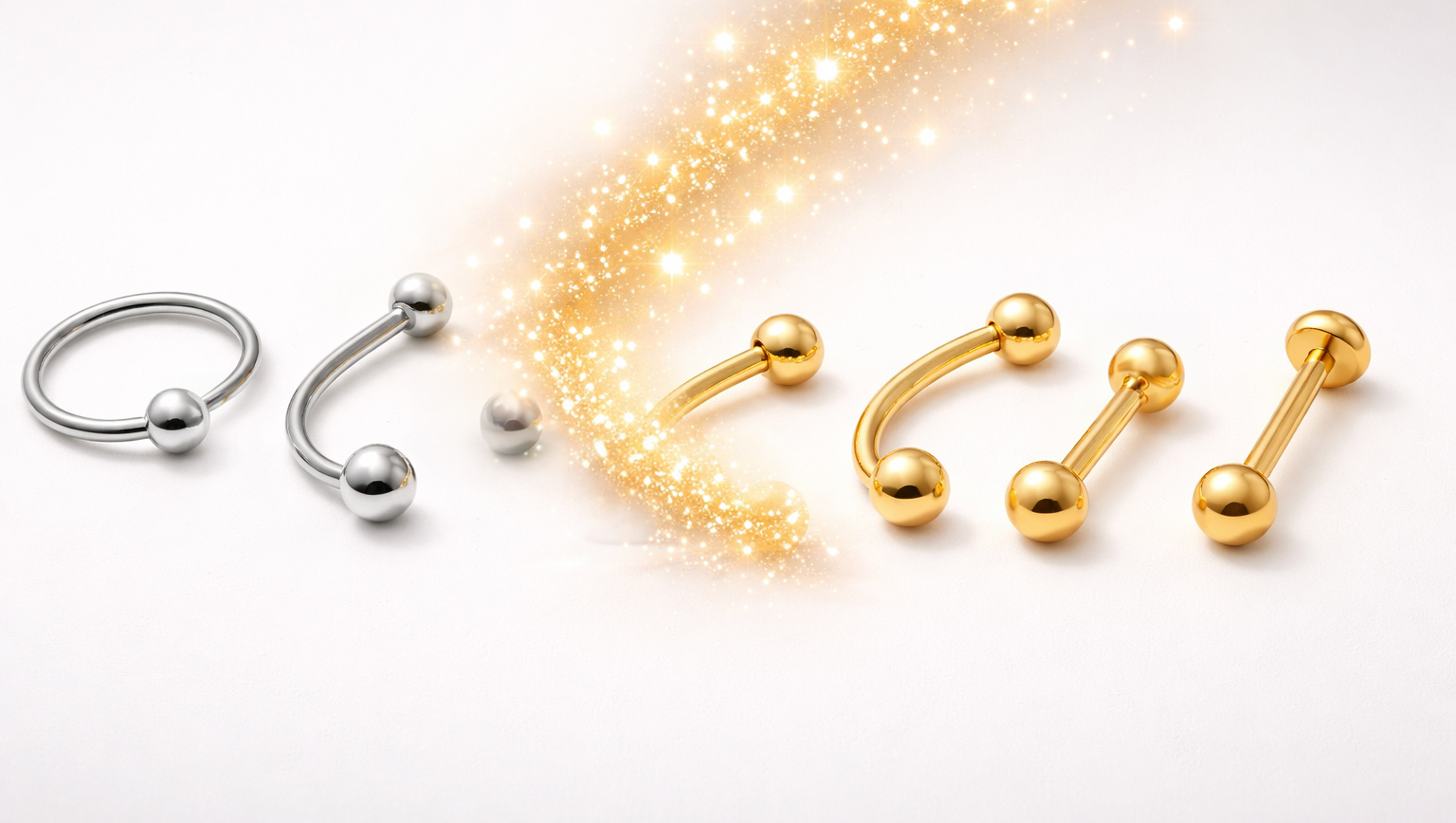
Why PVD matters in piercing jewellery
PVD coating has become increasingly common in piercing jewellery, particularly on pieces with gold, black or rose-coloured finishes. Despite its widespread use, questions remain about safety, durability and appropriate use in professional settings.
Body piercers need to understand what PVD is and how it works in order to assess the jewellery they offer to clients.
What does PVD mean?
PVD stands for Physical Vapour Deposition. It is a process in which a solid material is vaporised in a controlled environment and deposited on the surface of the jewellery, forming a very thin, adherent layer.
Compared with some electroplating treatments, a PVD process can produce a thin, controlled film. However, uniformity, adhesion and durability depend on the substrate, surface preparation, composition and process parameters. The word “PVD” alone does not guarantee a particular quality.
The result is a decorative finish that may offer greater wear resistance than some conventional electroplating methods; performance depends on the specific coating and product.
The difference between PVD and anodising
Although both processes can change the colour and finish of piercing jewellery, PVD and anodising work in different ways. PVD deposits a very thin layer of material on the jewellery surface, whereas anodising alters the metal surface—usually titanium—through an electrochemical process that forms a controlled oxide layer.
When titanium is anodised, an oxide layer forms on the surface and the colour results from light interference. PVD, by contrast, deposits material on top of the substrate. A coated piece cannot simply be anodised in the same way as bare titanium. Follow the manufacturer’s guidance and determine whether the coating must be fully removed before anodising.
Before any further processing, check the coating composition and the manufacturer’s instructions. Do not try to anodise, polish or remove PVD as though the surface were bare.
- stain or damage the PVD coating;
- cause colour loss or premature flaking;
- compromise the jewellery’s appearance and reliability.
If a studio intends to anodise a piece, it must be made from suitable titanium and have no coating. PVD should be treated as a final colour finish, not as a surface compatible with subsequent anodising.
Is PVD safe for initial piercings?
The safety of PVD-coated jewellery depends on more than the base material. Information is needed about the substrate, coating composition and adhesion, finish, wear and compatibility with the sterilisation method. PVD coating is not a biocompatibility certification.
Even if the substrate is titanium that conforms to a standard, this does not automatically establish that the coated product is suitable for an initial piercing. If data on the finished piece are unavailable, do not present it as suitable for a healing wound; prefer jewellery with documented material and finish.
For an initial piercing, the decision should be based on documentation for the finished piece, the client’s anatomy and a piercer’s judgement. For a healed piercing, PVD may be considered as a decorative finish only after taking wear, friction, individual sensitivity and sterilisation compatibility into account.
Durability and wear resistance
PVD can provide a coloured finish and some processes may offer good wear resistance compared with particular treatments. No general conclusion is possible without test data for the specific coating and piece of jewellery.
It is important to remember that the coating is a surface layer. Impact, continual friction or unsuitable sterilisation cycles may affect the finish over time.
Studios using an autoclave should verify that coated jewellery is compatible with the intended steam-sterilisation cycles. Not every manufacturer guarantees coating stability under repeated high-temperature exposure.
How to assess PVD coating quality
PVD coatings are not all the same. Quality depends on factors such as:
- the manufacturer’s identity and provenance;
- control of the deposition process;
- the layer’s thickness and uniformity;
- proper polishing of the surface before coating.
A quality PVD finish should look even, without spots, flaking or irregular colour changes. The supplier should identify the base material and, ideally, provide clear specifications.
Appearance alone is not enough for a body piercer. Supplier transparency and documentation for the base material are important factors.
Conclusion
PVD can broaden the range of available finishes without using more expensive solid materials such as solid gold. Gold, rose and deep black tones may be achieved with a modern, even finish.
PVD offers more aesthetic options, but colour and appearance do not prove the quality of the material or coating. Before recommending it, a professional should be able to verify the substrate, process, documentation, sterilisation compatibility and intended use.
The decision to use coated jewellery should also take account of the stage of healing, the client’s individual circumstances and the studio’s quality standards.
Sources and limitations
PVD describes a deposition process, not a single material composition or an automatic certification for body piercing. The safety of a finished piece depends on its substrate, the coating’s composition and adhesion, finish, wear, cleanliness and compatibility with the sterilisation cycle. Colour is not evidence of biocompatibility.
- Stanford Nanofabrication Facility — PVD — thin-film deposition by evaporation or sputtering
- Oerlikon Balzers — PVD processes — evaporation, sputtering and vacuum deposition
- FDA — ISO 10993-1 — risk-based biological evaluation of the finished product
- Association of Professional Piercers — Jewellery for Initial Piercings — materials, finish, anodising and initial-jewellery requirements
- CDC — Steam Sterilisation — material compatibility and steam monitoring
Sources consulted on 27 September 2026. Do not present PVD-coated jewellery as suitable for an initial piercing without manufacturer documentation for the finished piece.