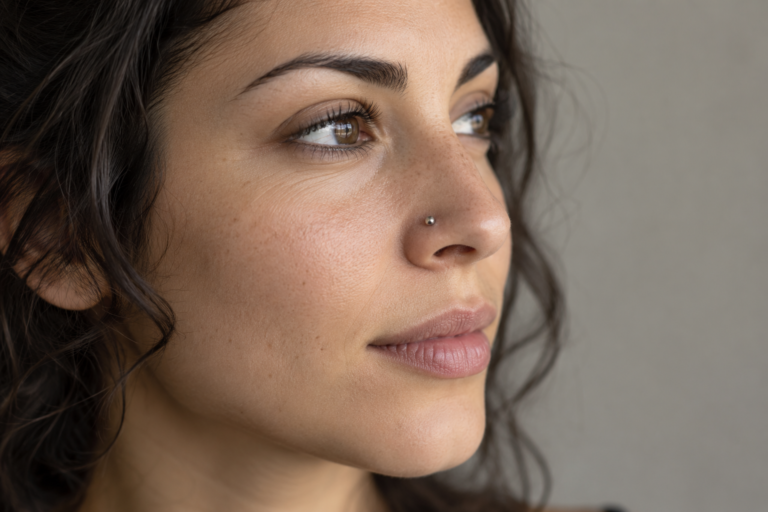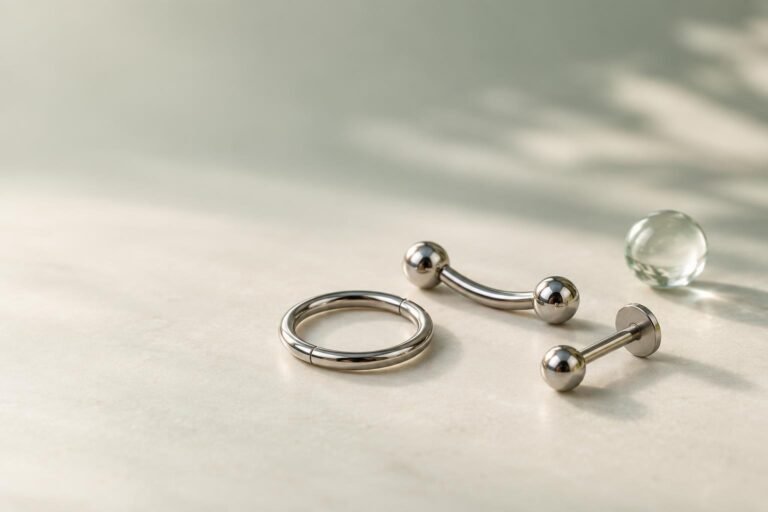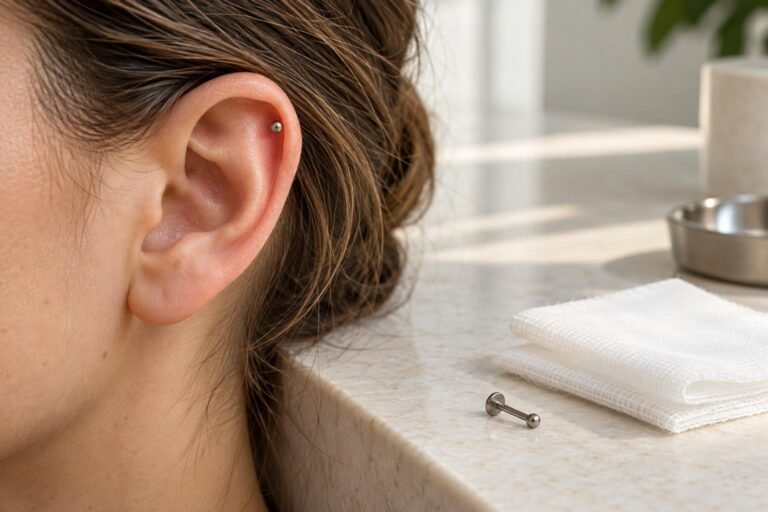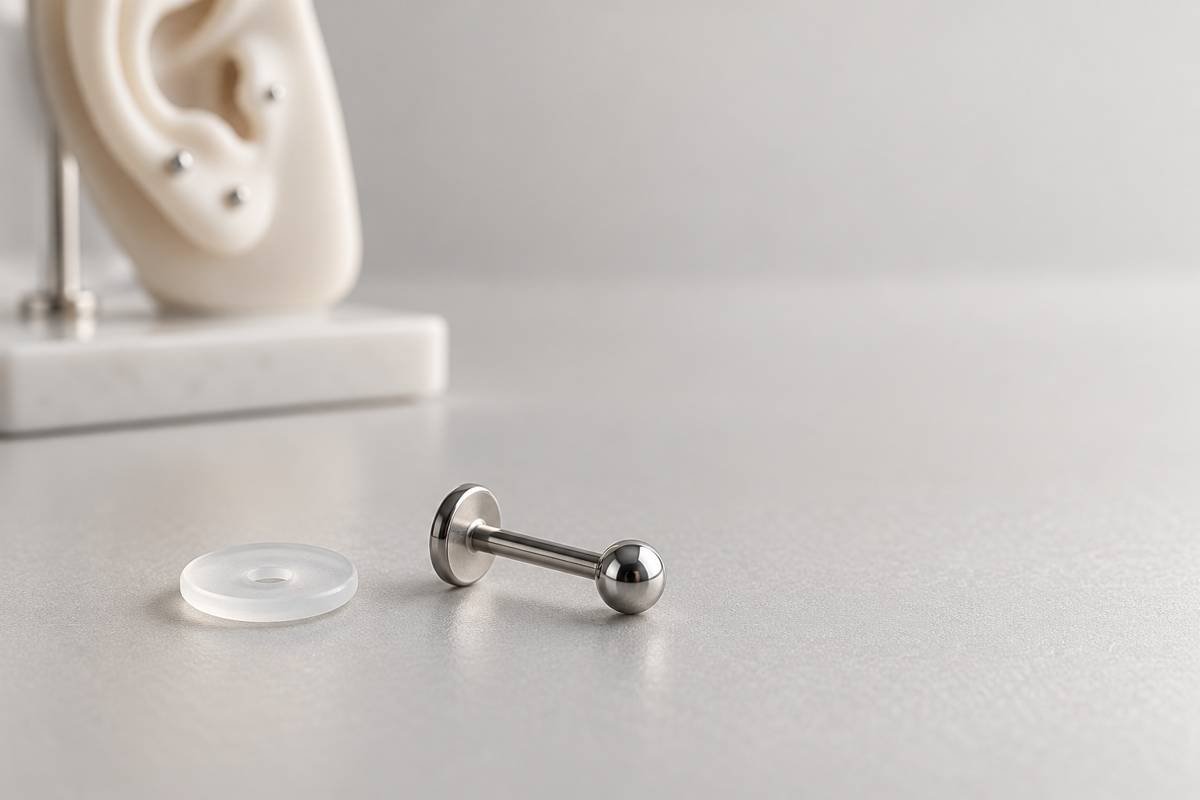
A bump near a piercing is often called a “bump” or “hypertrophic scar,” but these terms alone do not identify the cause. This may be, for example, irritation due to pressure, friction or unsuitable jewellery; a hypertrophic scar or a keloid are different possibilities and require appropriate evaluation. Silicone discs marketed as No-Pull Discs are sometimes offered to flatten or protect these bumps. But do they really work?
Short answer: I have not found reliable clinical evidence that discs applied to piercing jewellery heal piercing bumps or scars. Silicone studies mostly involve sheets or gels used on skin scars, not small discs fitted to jewellery. The possible mechanical effects of the disc also remain hypotheses to be evaluated on a case-by-case basis.
1. What can a “piercing bump” be?
“Bump” is a descriptive expression, not a diagnosis. A lump may be associated with irritation, repeated trauma, pressure, discharge, reaction to material, or other skin conditions. Appearance and symptoms alone do not always allow us to distinguish them with certainty.
A hypertrophic scar is a thickened scar that remains within the margins of the original lesion; it may appear in the following weeks and, in some cases, flatten over time. The keloid grows beyond the edges of the wound and tends to persist. The distinction is not based on a universal threshold of weeks nor on a percentage of "bumps" observed in studies: if the bump grows, persists or is a cause for concern, it is advisable to have it assessed by a doctor, in particular a dermatologist.
Severe or increasing pain, marked heat and redness, worsening swelling, heavy or foul-smelling discharge, red streaks or fever merit prompt contact with a healthcare professional. In case of possible infection, do not remove the jewellery yourself without clinical indication.
2. What do we know about silicone discs?
Available reviews of silicone for scars evaluate gel sheets or products applied to the skin, typically after the wound has closed. Even for these applications, the certainty of the evidence is limited or very low for several outcomes. It is not correct to automatically transfer those results to a disc fitted to piercing jewellery: shape, contact, pressure, position and management are different.
For No-Pull discs used with piercing jewellery, I have not found clinical studies in the sources consulted that demonstrate their effectiveness, define a safe protocol or establish which materials and wear times are appropriate. This does not prove that every use is ineffective; it means that you cannot present them as a proven treatment, universal solution or substitute for evaluation of the cause.
3. Compression and biomechanical hypotheses
A disc can change the way the end of the jewellery rests on the skin. Depending on the shape and fit, it may distribute contact differently or add thickness and pressure. However, it has not been proven to block the movement of the jewellery, correct an angle, reduce friction or "cushion" in a therapeutic way.
Compression therapy studied for some scars uses devices that apply pressure over larger areas; clinical evidence remains uncertain and does not establish a universal pressure applicable to a piercing disc. A small disc pressed against the skin is not equivalent to a compression garment or silicone sheet. Therefore, mmHg values, capillary closure thresholds and mechanisms such as hypoxia, fibroblast apoptosis or collagenase activation do not allow us to predict the effect of a No-Pull Disc.
4. Piercing risks and assessment
An accessory that is too tight or bulky can add pressure or friction, trap moisture and debris, and make cleaning more difficult. Jewellery that is too tight can hinder local circulation and the drainage of secretions; one that is too long can snag or suffer impacts. These risks depend on the anatomy, positioning and actual fit: they cannot be inferred simply from the material being described as "medical-grade silicone".
The acronyms or declarations relating to a material do not in themselves demonstrate that a specific disc is suitable for a piercing wound, compatible with jewellery or sterilisable using an arbitrary, pre-selected cycle. Before using any component, you should follow the manufacturer's verifiable specifications and applicable professional guidance; in the absence of reliable information, do not improvise sterilisation or reuse.
An experienced piercer can check the fit and identify possible mechanical factors, such as length, style, material, external pressure or angle. If an assessment of an injury or possible infection is needed, this should be done by a healthcare professional. Do not squeeze the bump. Do not shorten or replace jewellery yourself if it feels tight.
5. In practice: what to do
| Situation to assess | Prudent approach |
|---|---|
| Jewellery that moves, gets caught or seems too long | Have a qualified piercer check the style and length and whether it is appropriate to modify them. |
| Tight jewellery, skin under marked compression or an end sinking into the tissue | Seek prompt assessment; do not add a disc or force the jewellery. |
| A persistent or enlarging bump, or one that looks like scar tissue | Have the lesion evaluated by a doctor. A disc does not replace clinical diagnosis or treatment. |
| Increasing pain, heat, marked redness, heavy discharge or fever | Contact a healthcare professional promptly; do not remove the jewellery yourself if infection is suspected. |
In summary: silicone discs can change the mechanical contact between jewellery and skin, but there is not enough evidence to say that they cure hypertrophic scars or piercing bumps. Before thinking about an accessory, it is best to identify what is irritating or compressing the area and contact the appropriate professional.
Sources
- Association of Professional Piercers (APP), Body Piercing Troubleshooting — common problems, when to seek medical attention, and jewellery fitting.
- Association of Professional Piercers (APP), Jewellery for Initial Piercings — choice of size, style and material for healing piercings.
- DermNet, Keloid and hypertrophic scar — general clinical differences and scar course. Page review: September 2022.
- Cochrane, Silicone gel sheeting for preventing and treating hypertrophic and keloid scars — review of silicone sheets; heterogeneous studies and methodological limitations.
- Cochrane, Silicone gel sheeting for treating hypertrophic scars — the certainty of the evidence on the outcomes of silicone sheets is low or very low.
- Cochrane, Pressure garments for preventing hypertrophic scarring after burn injury — mixed evidence on compression therapy for burn scars; the review does not study piercing discs.
Sources consulted on 14 October 2026. The evidence on scars and compression does not provide evidence of effectiveness of discs applied to piercings.