
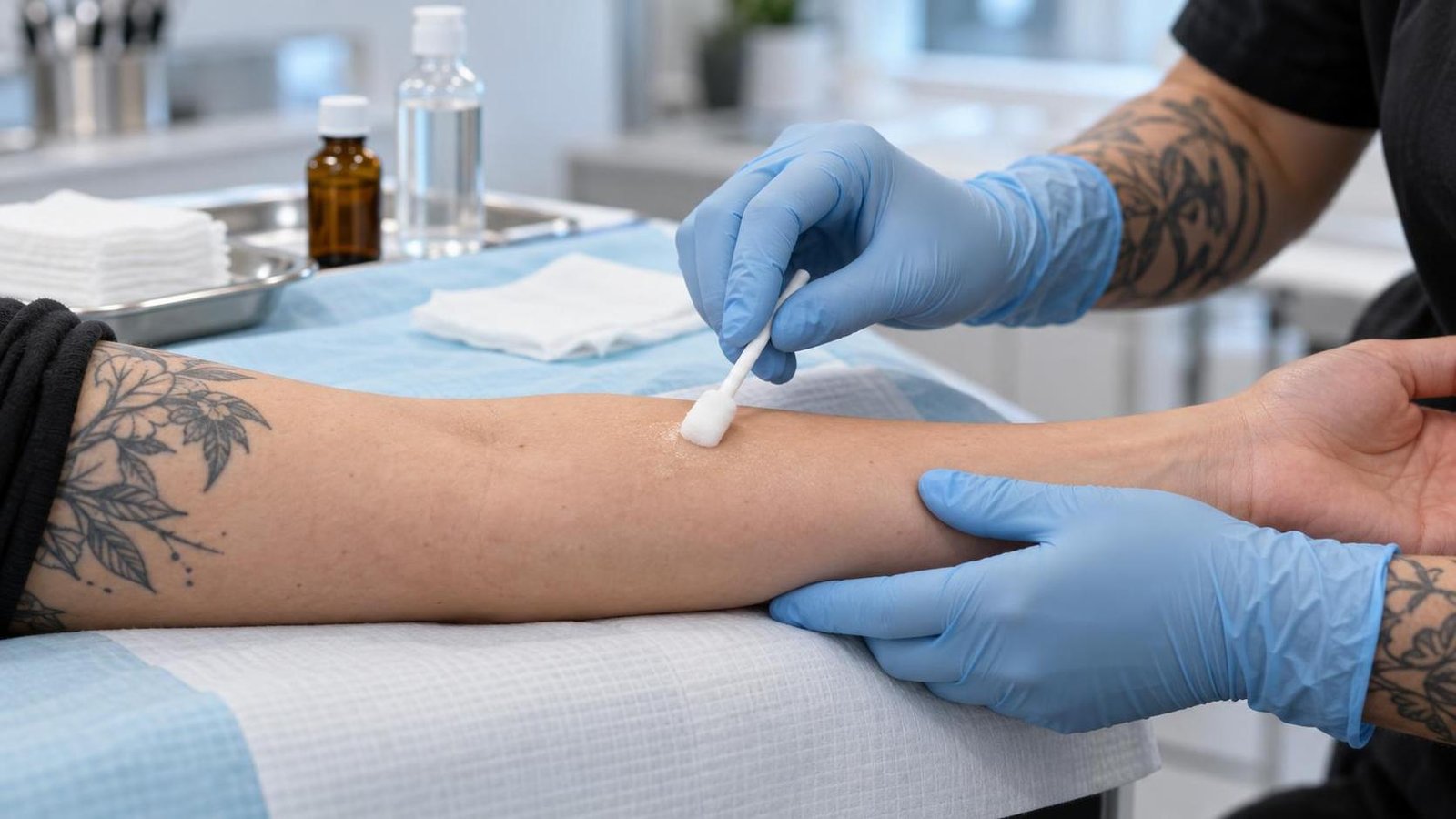
Purpose and limits of skin preparation
Autoclave sterilisation applies to instruments and jewellery compatible with that process; antiseptic preparation applies to the client's skin. These are complementary safeguards, not substitutes for one another. For instrument sterilisation, also see the autoclave guide. Preparation removes residue and reduces surface microbial contamination through friction and an appropriate antiseptic, used in accordance with the procedure and product instructions.
A topical application does not make skin sterile. Hand hygiene, suitable gloves, a controlled work area, sterile materials and measures to prevent recontamination remain necessary. Guidance on preparing intact skin for surgery belongs to the perioperative setting and should not automatically be transferred to every body-art procedure.
At a minimum, consider whether the skin is intact, the site, proximity to the eyes, ear canal or mucous membranes, reported allergies or sensitivities, the available formulation and the manufacturer's instructions. If lesions, dermatitis or other signs make it unclear whether the procedure is suitable, do not try to mask the issue with antiseptic: reassess and, where appropriate, postpone.
Choosing an antiseptic without overgeneralising
No single molecule or concentration can be considered suitable for every piercing site. Check that the product is indicated for the intended use and follow the manufacturer's instructions, including any repeat applications and drying times.
Read hospital or surgical guidance in light of the population, procedure and formulation it addresses. Recommendations for surgery on intact skin, for example, do not show that the same solution is suitable near the eye, in the ear or on mucous membranes, nor do they establish a universal piercing protocol.
Do not decant or top up containers if that conflicts with the label, studio procedures or applicable local rules. Use the format and dispensing method specified by the manufacturer and the studio's documented procedure.
Chlorhexidine: take care around sensitive areas
Chlorhexidine comes in different formulations, including aqueous and alcohol-based products, with concentrations and indications that are not interchangeable. The molecule's name alone is not enough: check the specific formulation and intended site of use.
A key concern is injury if a skin preparation not intended for ophthalmic use gets into the eye. Labels for some chlorhexidine skin products warn against eye contact; some describe possible serious eye injury and hearing damage if the product reaches the middle ear, for example where the eardrum is perforated. Formulation and route of exposure matter: protect the area from drips and splashes and do not extend a product's instructions beyond its stated sites.
Do not improvise with a chlorhexidine skin preparation for procedures near the eyes or ear canal. Confirm that the product is expressly indicated for that site and use; without clear confirmation, do not use it near the critical area and follow a validated professional protocol. An aqueous solution is not automatically safe for the eye or middle ear.
Ask about known reactions to ingredients and read the product warnings. Do not resolve a reported reaction or uncertainty by independently substituting another antiseptic: consider postponement and, where appropriate, healthcare advice.
Povidone-iodine: the formulation determines its use
Povidone-iodine is available in different products and formulations. Check the concentration, excipients, indications and directions on the label of the product actually used in the studio. Do not assume all 10% products have the same contact time or are authorised for the same sites.
A US label consulted for a 10% povidone-iodine solution says that, for pre-operative preparation, it should be applied to cleaned skin and allowed to dry for at least two minutes before the field is draped. That is a specific instruction for one product and setting, not a universal timing for every brand or for body piercing. Warnings concerning allergies, thyroid conditions, pregnancy, newborns or other circumstances also depend on the product and the person: check the label and applicable healthcare advice.
The colour may make the treated area visible, but it does not prove adequate coverage or that the product has completed its action. Do not confuse drying time with a standard contact time independent of the label.
Alcohol and combination products
Alcohol may be used alone or as part of a combination formulation. Evaporation rate, residual activity, skin compatibility and flammability risk vary by product and context, so alcohol is not a shortcut for defining a protocol. Its presence does not make a product suitable for every site.
If preparation uses an alcohol-based vehicle, wait until it is fully dry and follow the label precautions before starting. Do not use a standard time inferred from the active ingredient alone.
A degreasing step, if included in the studio procedure, does not replace antisepsis. Avoid soaps or cleansers incompatible with the formulation; check the manufacturer's directions rather than relying on general rules about isolated ingredients.
A cautious sequence before piercing
1. Assess the skin and gather relevant information
Check that the area is suitable and ask about relevant allergies or known reactions to the intended products. If there is significant uncertainty about the skin or product safety, stop preparation and resolve it before proceeding.
2. Clean when needed
Remove visible dirt, sebum, cosmetics or residue using a method compatible with the procedure. If the antiseptic requires previously cleaned skin, follow that instruction and remove the cleanser completely where directed. Do not introduce incompatible cleansers without checking the label.
3. Apply with a controlled technique
Use the intended applicator and cover enough area without passing over the prepared point with material contaminated at the periphery. Where the procedure calls for it, use friction and move from the centre outwards; the technique must remain compatible with the formulation and manufacturer's directions. If the client or an object contaminates the area, repeat the preparation with clean material in accordance with the studio's procedure.
4. Allow the product to dry and protect the area
Wait for the time specified for the product and procedure. Do not speed drying by blowing or fanning over the skin, and do not blot if the label says to air-dry. Before piercing, check that the area is dry and free of pooling or drips, especially near the eyes, ears and mucous membranes.
5. Mark without recontaminating
Plan marking so it does not undo the preparation. If the product may remove the mark or marking contaminates the site, follow a documented local sequence using appropriate single-use or sterile instruments. The sources cited here do not establish one marking method for every studio.
Pre-procedure preparation and aftercare are different
An antiseptic used to prepare intact skin before a procedure does not automatically become suitable for daily care of a healing piercing. Do not recommend chlorhexidine, povidone-iodine, alcohol or hydrogen peroxide for aftercare merely because they were used during preparation.
For home care, refer to piercing-specific aftercare guidance and individual circumstances. A gentle routine may include sterile saline for rinsing or clean running water, in line with reliable piercing aftercare guidance. If concerning symptoms develop, aftercare does not replace healthcare assessment.
Frequently asked questions
Is chlorhexidine always the best choice?
No. Formulations differ and the anatomical site matters. Surgical guidance for intact skin does not mean the product is suitable for use near the eyes, ears or mucous membranes, nor does it establish a universal protocol for piercing.
Must povidone-iodine always be left for two minutes?
There is no timing that applies to every product. One label consulted specifies at least two minutes of drying for a particular pre-operative preparation; follow the label of the formulation actually used.
Can I use alcohol alone before every piercing?
Do not infer that from a general rule. Check product suitability, site and applicable procedure, and follow the manufacturer's directions.
Can I keep using the antiseptic while the piercing heals?
Not automatically. Pre-procedure preparation and care of a healing piercing have different purposes. Follow specific aftercare guidance and seek healthcare advice if problems arise.
Sources and scope
- Association of Professional Piercers (APP), Procedure Manual (2013), "Skin Preparation" section — purpose of preparation, friction, centre-outward movement and following the manufacturer's instructions.
- World Health Organization (WHO), Global Guidelines for the Prevention of Surgical Site Infection, 2nd ed. (2018), recommendation 4.7 — chlorhexidine in alcohol for surgical preparation of intact skin; surgical scope, not a universal piercing protocol.
- DailyMed, Povidone Iodine Prep 10% label (updated 2025) — specific example: clean skin and allow it to dry for at least two minutes before draping; not a universal drying time for all piercing sites.
- FDA, Hibiclens label (4% chlorhexidine gluconate, 2021) — warnings to avoid eyes, ears and mouth; describes serious risks from exposure or entry into the middle ear.
- DailyMed, 3M SoluPrep S label (2% chlorhexidine/70% isopropyl alcohol) — example of a formulation and pre-operative indications; not automatically suitable for every piercing site.
- Association of Professional Piercers (APP), Aftercare — a separate reference for home piercing care.
Sources consulted on 14 October 2026. Surgical evidence and documentation for individual products do not by themselves define Italian legal duties or a complete clinical protocol for body piercing. Always check the local label, technical data sheet and rules applicable to the studio.