

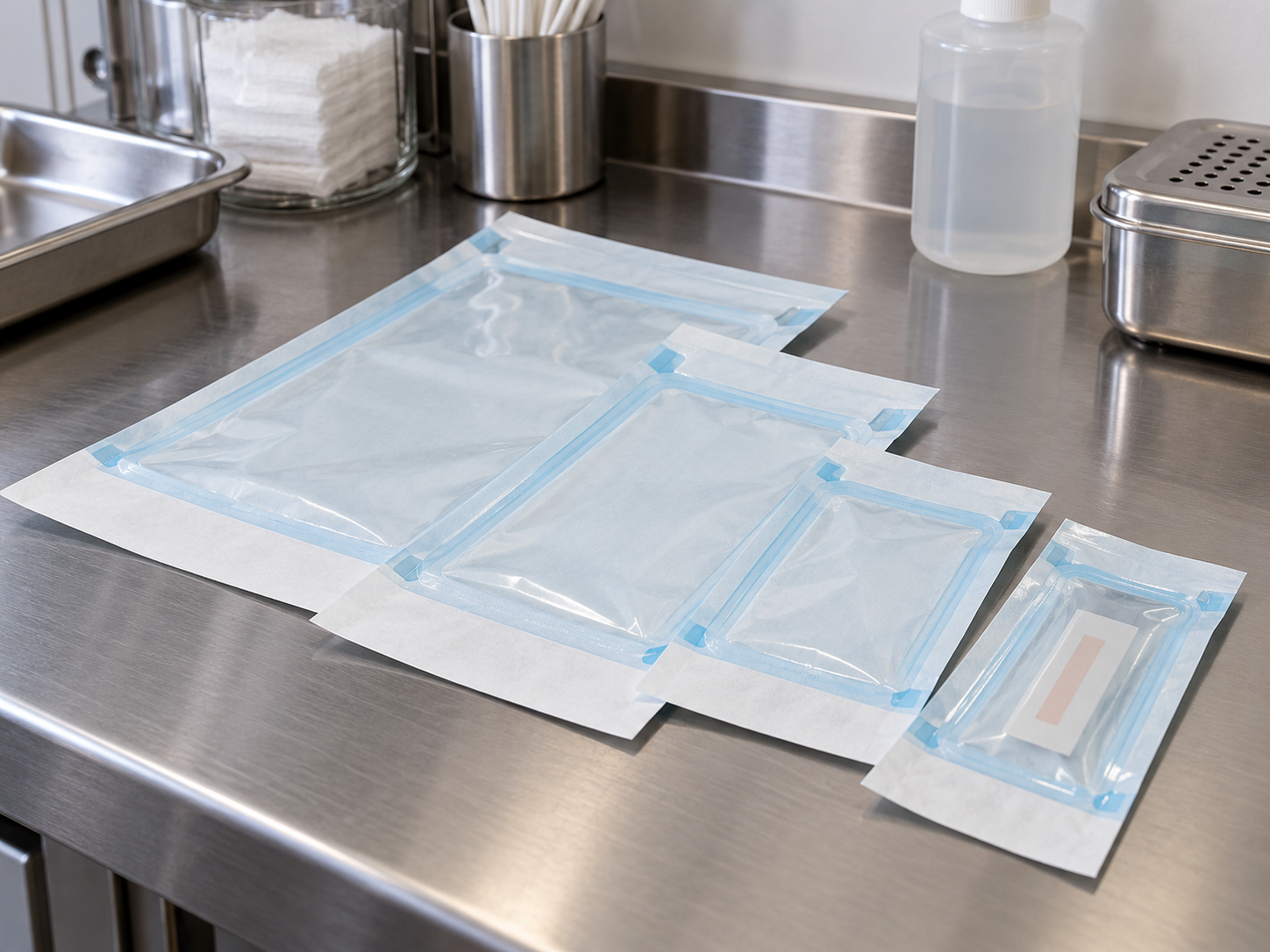
What do sterilisation pouches do, and how do they work?
A pouch does not sterilise an instrument. It packages it for the intended cycle and helps maintain sterility after processing, provided the package remains intact and is stored correctly. In paper-and-film pouches compatible with steam, the porous side allows the sterilising agent to pass through, while the transparent film makes the contents visible. Materials and construction vary by method, so a pouch is not automatically suitable for every steriliser.
Before packaging, the instrument must be cleaned, dried and inspected in accordance with the applicable instructions. A wet, torn or punctured pouch is not a reliable barrier. Sterilisation depends on the entire process—preparation, packaging, loading, cycle and checks—not on the package alone. (CDC: preparation and packaging; Sterimed: paper-and-film packaging.)
Types and formats
It is useful to distinguish the format from the sealing method:
- Preformed pouches: ready to use; some are self-sealing with an adhesive strip, while others require a heat sealer.
- Rolls: cut to the required length and heat-sealed at the open ends. Flat and gusseted versions are available; gusseted rolls can accommodate bulkier contents.
The pouch material (for example, paper and film) and type must be compatible with the sterilisation method and instruments. Available categories and seals vary by manufacturer; always check the intended use and product instructions. (Euronda: flat and gusseted rolls, and self-sealing pouches; STERIS: types and instructions for use.)
How to choose the size and use a pouch correctly
- Start with the instrument and method. Follow the device’s reprocessing instructions and select a pouch specifically compatible with the intended method and cycle.
- Allow adequate space. The instrument should fit without being forced or compressing the package, leaving enough space for a complete, even seal. An undersized pouch may make packaging and opening difficult or may be damaged; a larger pouch is not automatically safer. Clearance and fill limits depend on the product—there is no universal size or percentage.
- Seal as specified. Use the adhesive strip or heat sealer in accordance with the pouch instructions, including any specified sealing parameters. Do not leave folds or channels in the seal.
- Load and check. Arrange packages as directed by the steriliser manufacturer. After the cycle, and before storing or using the instrument, check that the pouch is dry and that the seal and material are intact. Interpret indicators according to the protocol: a chemical indicator alone does not prove that every cycle parameter was achieved.
The right size helps avoid forcing the instrument, allows correct sealing and supports the intended handling; it does not replace validated compatibility or process monitoring. (STERIS: sizing and manufacturer instructions; CDC: packaging and verification of sterilisation.)
Mistakes to avoid
- Choosing only by price or external dimensions without checking compatibility and instructions.
- Forcing instruments into a pouch or filling it beyond the specified limits.
- Reusing single-use packaging or using a wet, torn pouch or one with a faulty seal.
- Treating an indicator’s colour change alone as proof of sterility.
If the documentation does not clarify intended use or compatibility, confirm with the manufacturer before using the product.
Frequently asked questions
Is there a standard pouch size for piercing instruments?
No. Choose according to the instrument, sealing method and pouch-specific instructions. Minimum clearances and fill limits are not universal.
What is the difference between a self-sealing pouch and a roll?
A self-sealing pouch has a ready-to-use adhesive closure. A roll is cut to the required length and sealed with a heat sealer. Preformed pouches that require heat sealing are also available.
Is a pouch suitable for every steriliser?
No. Check the method and compatibility in the manufacturers’ instructions.
Will packaging sterilise a dirty instrument?
No. Cleaning, drying and preparation must take place before packaging.
Sources and further reading
- CDC — Best Practices for Sterilisation in Dental Settings: cleaning, drying, inspection and the role of packaging.
- CDC — Sterilising Practices: packaging, cycles and monitoring.
- Euronda — Sterilisation rolls and pouches: examples of formats and seals.
- Sterimed — Paper-based pouches: features of paper-and-film packaging.
- STERIS — Guide to Sterilisation Pouches: choosing pouch size and type, and using it according to the manufacturer’s instructions.
- FDA — Reprocessing Medical Devices in Health Care Settings, 2015: reprocessing instructions for reusable devices.
Guidance for medical devices does not replace local requirements applicable to piercing studios.