
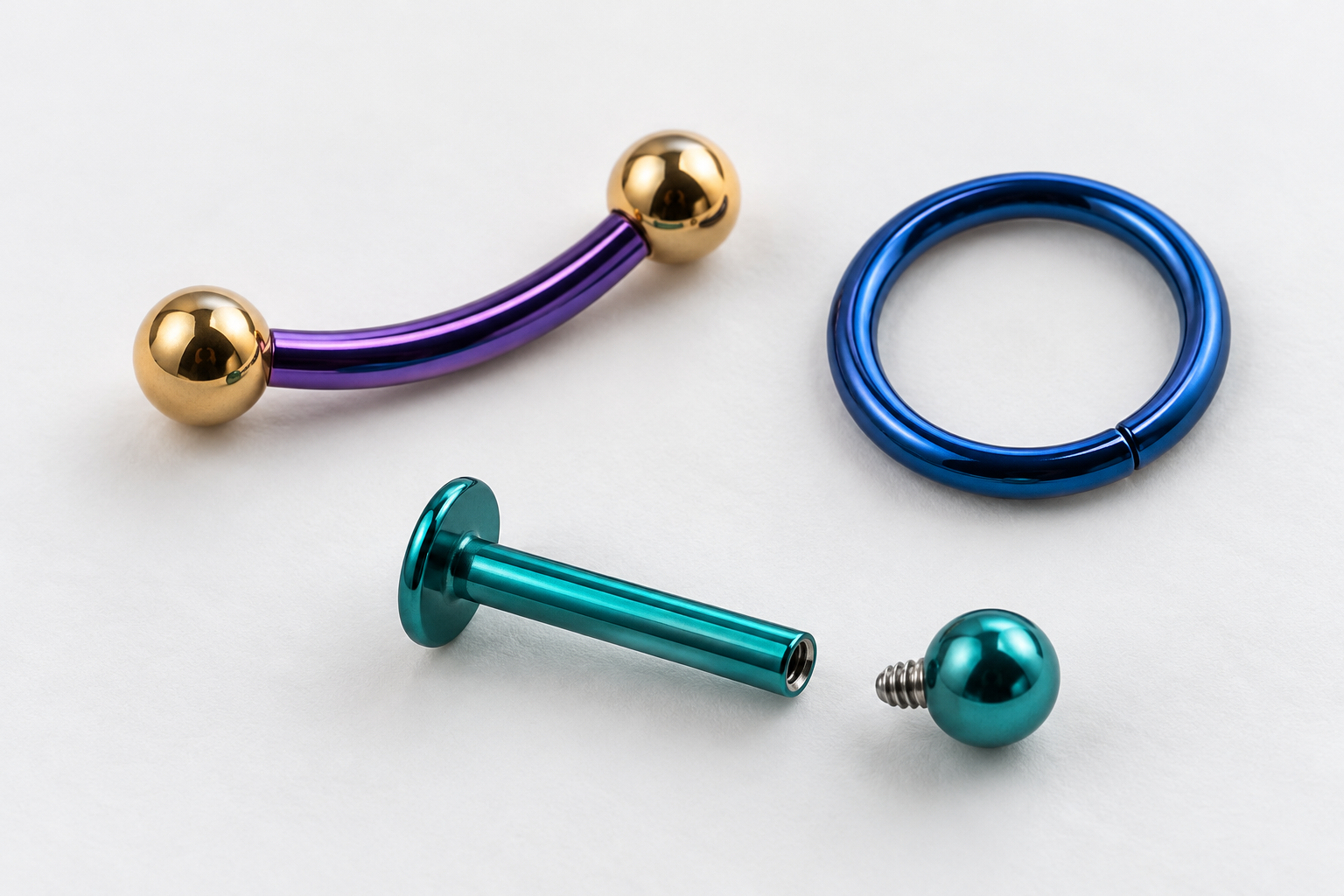
In brief. Anodising is not a paint: it creates an oxidised surface that changes reflected light. The Association of Professional Piercers (APP) describes anodised titanium and niobium as coloured options for piercing jewellery and notes that fading caused by wear or body chemistry is not harmful. That does not automatically make every piece of jewellery suitable: the alloy, documentation, workmanship and finish all matter.[1]
What is colour anodising?
Anodising is an electrochemical treatment that grows an oxide layer on the metal surface. In titanium, materials research describes titanium oxide formation and structural colours linked to how the surface interacts with light; this is not simply a matter of applying coloured pigment.[2] [3]
This optical explanation helps show why the shade can change with the treatment. It is not enough, however, to infer a particular voltage or clinical outcome. The cited scientific papers study titanium surfaces in materials-research settings; they do not provide validated instructions for every piece of body-piercing jewellery or certify any product.
How to interpret colours and voltages
The perceived shade depends on the process used to create the surface. Research on coloured titanium considers voltage and oxidation time among its experimental parameters; changing the conditions also changes the structures and colours observed.[3] An experimental result from one sample is not a universal chart for jewellery made from different alloys, suppliers and finishes.
The tables below present separate published colour references; keep their sources distinct. The voltages are indicative: they are not guaranteed settings, nor certification of the material or jewellery quality.
Practical reference for anodising piercing jewellery
Brian Skellie describes his table as the scale he uses in his own set-up; the same handout warns that results vary with the metal (titanium, titanium alloy or niobium), electrolyte solution, cathode and tank size, and polishing. It suggests building your own reference scale, starting at a lower voltage.[5]
| Indicative voltage | Reported shade |
|---|---|
| 8–10 V | Copper |
| 15–16 V | Dark purple |
| 18–20 V | Dark blue |
| 27–30 V | Light blue |
| 40–45 V | Bright, almost white |
| 48–50 V | Yellow |
| 62–63 V | Fuchsia |
| 72–75 V | Blue-purple |
| 81–85 V | Teal |
| 91–92 V | Green |
Separate reference for niobium
In his primer on pure niobium, Bill Seeley describes a continuous spectrum and explains that the values are approximate, with shades changing from one volt to the next. These reference points relate to niobium and should not be converted into a titanium scale.[6]
| Indicative voltage | Reported shade |
|---|---|
| 5 V | Light gold |
| 12 V | Yellow-brown |
| 15 V | Purple |
| 20 V | Dark blue |
| 30 V | Medium blue |
| 40 V | Light blue |
| 50 V | Yellow |
| 60 V | Yellow gold |
| 65 V | Pink |
| 75 V | Purple |
| 85 V | Teal |
| 90 V | Green |
A separate study offers independent evidence, but its curve is not interchangeable with the references above. A study of Ti-6Al-4V alloy for dental use reports gold at 10 V, yellow at 60-65 V and pink at 70-80 V under the experimental conditions described as TSP/90.[7] The difference from the practical scale above is a reason to retain the source and context alongside each value, not to merge the two tables. These figures are not a calibration for every ASTM F136 piece of jewellery.
The shade can vary with the alloy, surface preparation and set-up used. The available sources do not support a universal chart for different materials and conditions: treat the references above as context-specific examples, without combining them or treating them as a standard.
The APP guide consulted describes the possibility of achieving different colours, but does not provide a voltage chart to apply universally to both materials.[1] Always check which metal, alloy, finish and process a chart describes; do not use colour to infer jewellery grade or suitability.
Titanium, niobium and jewellery quality
For an initial piercing, the choice starts with the quality and documentation of the piece, not its colour. In its guide to initial piercing jewellery, the APP lists titanium reference grades including ASTM F-136, ASTM F1295 and ISO 5832-3, as well as commercially pure titanium compliant with ASTM F-67.[1]
| Material | What to check | What not to infer from colour |
|---|---|---|
| Titanium | The alloy and its manufacturer documentation; the APP lists the ASTM/ISO references above. | A bright shade alone does not prove the grade, provenance or suitability of the jewellery. |
| Niobium | Material identity and supplier information. The APP describes its established use in piercing and the possibility of anodising it. | Do not automatically transfer experimental titanium charts to niobium. The APP guide consulted specifies that niobium has no "implant-grade" designation. |
Material certificates can document the grade of the raw material; the APP cautions that the document alone may not establish whether a specific piece of jewellery came from the stated batch. Ask the supplier for traceability consistent with the product purchased.[1]
Workmanship also matters: the APP recommends smooth, mirror-polished metal surfaces free of notches, scratches, burrs and polishing residue. The source does not justify a universal numerical roughness threshold for every piece of jewellery, so no Ra value is given here.[1]
For more on selection and documentation criteria, see the guide to piercing materials and the article on ASTM F136 titanium.
Colour, wear and compatibility
The APP notes that anodised colours on titanium and niobium can fade because of body chemistry or in areas subject to friction, and that this is not harmful.[1] An aesthetic change is not a measure of material quality, does not certify the treatment and cannot by itself be used to assess the piercing.
For jewellery intended for an initial piercing, consider together the size and style suited to the site, documented material and defect-free finish. Colour comes after these considerations. Anodising cannot correct an undeclared alloy, defective surface or unsuitable geometry.
Limits of operational instructions
This is an informational guide, not an anodising procedure. It does not provide pickling recipes, concentrations, temperatures, timings, bath compositions, electrical connections or sterilisation sequences: these are not instructions that can safely be derived from a colour chart.
ASTM F86 concerns the surface preparation and marking of metallic surgical implants. The standard describes surface treatments related to removing contaminants and passivation, but specifies that treatment selection depends on the material and contaminants and that its provisions do not cover every safety issue. It is not an operational manual for anodising piercing jewellery.[4]
Safety and liability notice. This guide is for informational purposes only: it is not an operating procedure and does not replace technical training, the current user manual for the anodiser, the jewellery manufacturer's instructions or product safety data sheets. Before any processing, check that the equipment, accessories, materials and process are compatible with the specific item; observe all limits and precautions stated by the manufacturer and applicable procedures. The operator is responsible for carrying out the checks and performing the work correctly. To the extent permitted by law, MyPiercing disclaims liability for damage or problems arising from use of the equipment or application of this information without following the manufacturer's instructions and relevant safety rules.
If there are no instructions compatible with the specific item, ask the supplier to confirm rather than adapting a recipe found online.
In-studio selection checklist
- Has the supplier identified and documented the material and alloy?
- Is the finish smooth and free of scratches, burrs or residue?
- Are the size, style and fastening system suitable for the intended piercing?
- Is the shade treated as an aesthetic feature, without promises based on an isolated voltage?
- Do the jewellery maintenance and sterilisation instructions come from its manufacturer?
If any answer remains uncertain, set aside the aesthetic assessment and first clarify the material, traceability and manufacturer guidance.
Frequently asked questions
Does anodising add paint or pigment?
For titanium, the literature describes structural colours associated with the surface oxide layer; the APP presents anodising as a way to obtain coloured titanium jewellery without affecting its safety when the jewellery itself is suitable.[2] [1]
Can I use an online chart to set the voltage?
Yes, as an approximate reference and only if you know its source, metal and context. The scales shown here do not guarantee a shade on your jewellery: check the specific process and the manufacturer's instructions; do not improvise parameters or substances.
If the colour fades, is the jewellery dangerous?
Not necessarily: the APP says that fading of anodised colours due to body chemistry or friction is not harmful. Jewellery quality and suitability should still be assessed by material, finish and documentation, not colour alone.[1]
Sources
- Association of Professional Piercers, "Jewelry for Initial Piercings". Materials and finishes for initial piercings; anodised titanium and niobium; possible colour fading. Accessed 14 October 2026.
- Alipal et al., "Evolution of anodised titanium for implant applications", scientific review, 2021. Context: titanium surfaces for implant applications; not a guide to piercing jewellery. Accessed 14 October 2026.
- Yang et al., "Tuning Structural Colors of TiO2 Thin Films Using an Electrochemical Process", Molecules, 2022. Study of thin films and experimental parameters; the results are not a universal jewellery chart. Accessed 14 October 2026.
- ASTM International, ASTM F86-21, "Standard Practice for Surface Preparation and Marking of Metallic Surgical Implants". Scope and limitations of the standard accessed 14 October 2026.
- Brian Skellie, "Anodizing Is Awesome!", 2023 revision, technical handout hosted by Australasian United Professional Piercers. Accessed 14 October 2026.
- Bill Seeley, "Niobium: A Primer in the Semi-precious...", Santa Fe Symposium on Jewelry Manufacturing Technology, May 2003. Accessed 14 October 2026.
- Wadhwani et al., "Colorizing titanium-6aluminum-4vanadium alloy using electrochemical anodization: Developing a color chart", The Journal of Prosthetic Dentistry, 119(1), 26-28, 2018. DOI: 10.1016/j.prosdent.2017.02.010. Accessed 14 October 2026.