
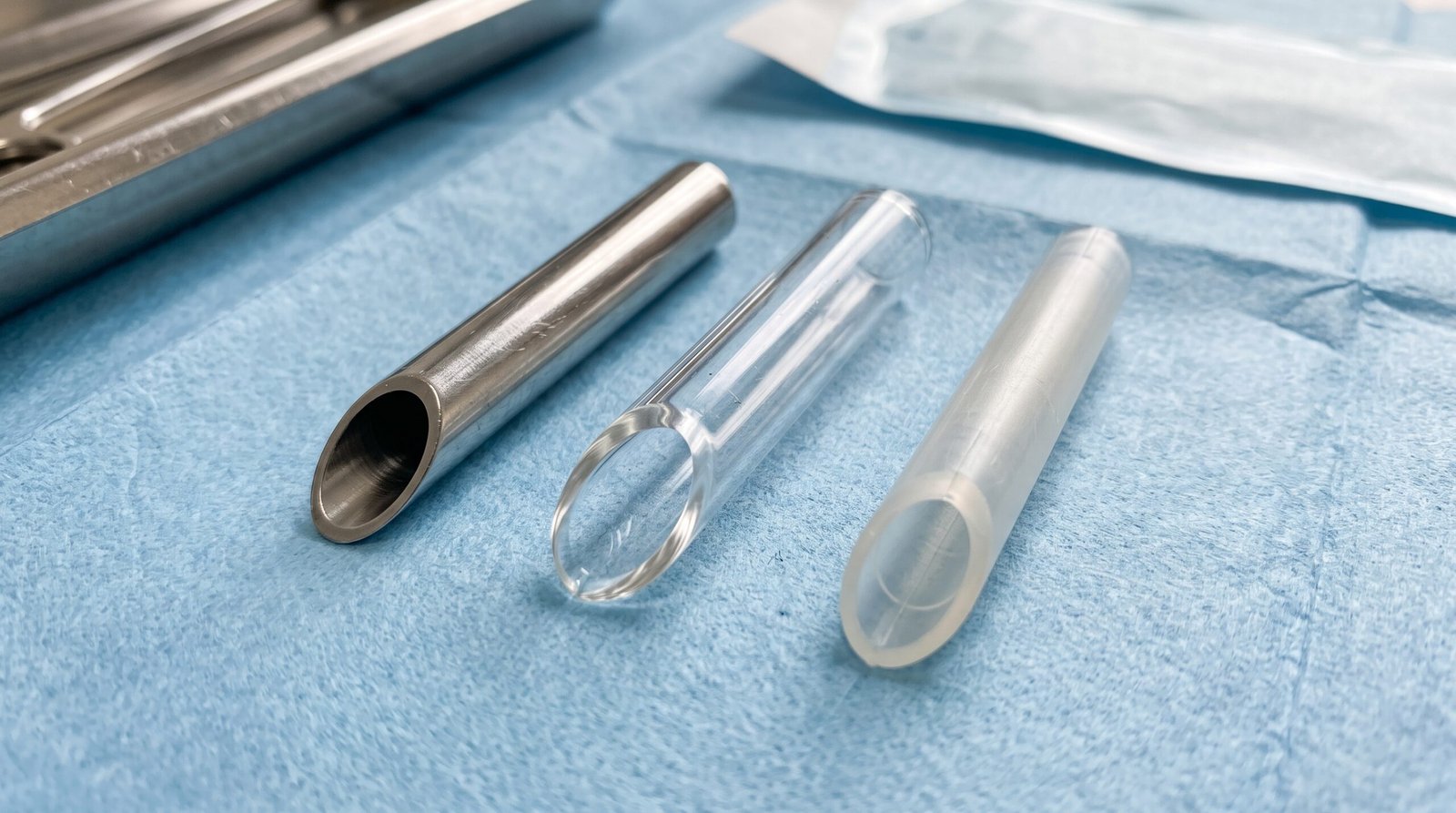
Three categories, different criteria
Receiving tubes may be made of stainless steel, glass or materials labelled for single use. They are not equivalent simply because they serve the same function: geometry, finish, diameter, strength and the manufacturer’s instructions all matter.
In some techniques, the hollow tube receives the needle tip on the opposite side and provides support; its function and method of use vary with the model and technique. There is no universal size to infer from the material.
To compare models, check the following in practice:
- an internal diameter suitable for the intended needle, without snagging or interference;
- a length and shape manageable for the site and technique used, with a stable grip;
- smooth surfaces with no chips, burrs, cracks or deformation;
- compatibility with the intended use and clear instructions for cleaning, inspection and reprocessing or disposal.
A proper comparison therefore considers design, inspectability and product instructions, not just the material.
Stainless steel: reuse only with an IFU
A stainless-steel receiving tube is reusable only if the manufacturer states this and provides adequate instructions. The term “steel” alone does not identify the alloy, finish or performance.
Assess the lumen, joints and surfaces against the specified cleaning method and whether they can be inspected. If the tube is deformed, defective or cannot be checked for cleanliness, remove it from service.
Glass: fragility and checks
Glass may offer a different view, but it can chip or break and may have temperature limits. Follow the technical data sheet for sterilisation and handling; cracks or damaged edges rule out use.
Do not assume that all glass is autoclavable or that transparency demonstrates cleanliness. Deal with any breakage using the procedure for sharps and contaminated material.
Single-use: use once only
A single-use product is intended for one use only: do not reuse or resterilise it. “Single-use” does not automatically mean “sterile”. For invasive use, check that the label explicitly states that it is sterile and that the barrier packaging is intact; also check the use-by date if one is shown. If sterility is not stated or the packaging is compromised, do not consider it sterile.
Follow the IFUs for opening and disposal. Consider availability, traceability and waste without compromising safety; record the model and batch where required.
- Check the code, intended use and single-use/reusable designation.
- Assess diameter, length, stability, cleanability and compatibility with the intended technique.
- Do not infer performance or sterility from the material or appearance.
FAQs
- Is stainless steel always reusable? No: the manufacturer’s statement and IFU are required.
- Is glass always autoclavable? No: check the model’s instructions.
- Does single-use mean sterile? No: check the sterility statement and that the packaging is intact.
Sources and limitations
Sources consulted on 13 October 2026. The CDC and WHO describe general reprocessing principles but do not qualify specific receiving tubes. For each model, reusability, cleaning, sterilisation capability and temperature limits must be checked in the manufacturer’s instructions. For devices within its scope, EU Regulation 2017/745 distinguishes a “single-use” designation from sterile status and the information on sterile packaging (Annex I, points 23.2–23.3); it should not be assumed that every piercing accessory falls within this Regulation.


